Answering the common buyer question: which 1/4-28 heim joint rod end bearings should I choose for reliable motion control and easy installation? This guide highlights five solid options that cover different priorities—from strongest load capacity to corrosion resistance and bulk-pack value. Each product is best for specific needs: high-load industrial links, frequent alignment adjustments, or budget-friendly assemblies. The following table summarizes key details to compare at a glance before diving into individual product profiles.
| Product | Bore / Thread | Material | Best For |
|---|---|---|---|
| ZOWZEA 2Pcs PHSB4 | 1/4″ bore, 1/4-28 RH | #45 steel, hardened bearing steel ball | Heavy duty, high load applications |
| HiPicco CF4 | 1/4″ bore, 1/4-28 RH | #45 steel, hardened bearing steel ball | High misalignment tolerance and strength |
| Yeebyee PHSB4 | 1/4″ bore, 1/4-28 RH | #45 steel, hardened bearing steel ball | Value pack with reliable wear resistance |
| uxcell PHSB4 | 1/4″ bore, 1/4-28 RH | #45 steel, hardened bearing steel ball | Corrosion resistance and longevity |
| Waziaqoc PHSB4 4-Pack | 1/4″ bore, 1/4-28 RH | Alloy steel, corrosion resistant | Versatile use with good price-per-unit |
ZOWZEA 2Pcs PHSB4 Rod End Bearing

The ZOWZEA set uses a 1/4″ bore with a 1/4-28 right-hand male thread and jam nuts for secure installation. Its #45 steel body is forged for strength, and the bearing steel ball is designed for wear resistance and longevity. It supports a static load of 7.7 KN and a dynamic load of 4.5 KN, making it suitable for demanding industrial linkages. Best for operators prioritizing robust construction and longer service life in high-stress machinery. A caution: ensure alignment is within the stated angular range (up to 9 degrees) to avoid premature wear.
HiPicco CF4 Rod End Bearing

HiPicco CF4 offers a 1/4″ bore and 1/4-28 right-hand female thread with jam nuts included. Constructed from #45 steel with a solid forging process and a hardened bearing steel ball, it delivers strong wear resistance. Maximum angular misalignment reaches 13.5 degrees with a static load capacity around 14.27 KN. This makes it well-suited for applications needing greater adjustment tolerance and higher static loads. Choose this if you require larger misalignment tolerance and solid reliability; caution may be needed for tight installation spaces due to jam nut spacing.
Yeebyee PHSB4 Rod End Bearings

Yeebyee provides a 1/4″ bore with 1/4-28 right-hand female thread and four-pack jam-nut-ready bearings. The #45 steel body with hardened bearing steel ball joints offers solid wear resistance and corrosion protection. With a 13-degree maximum angular misalignment and a static load capacity of 7.7 KN (dynamic 4.5 KN), this option balances cost with durable performance. Best for multi-point projects where more units are needed without sacrificing basic strength. A limitation: performance hinges on proper lubrication and alignment within stated tolerances.
uxcell PHSB4 Female Rod End Bearing

uxcell’s model features a 1/4″ bore with 1/4-28 right-hand thread and self-lubricating joint design. The inner ring is chromium-plated for corrosion resistance and the rod end body is zinc-plated to improve wear protection. This makes it a practical choice for assemblies exposed to moisture or routine maintenance constraints. Best for projects emphasizing rust resistance and low-maintenance operation; limitation: self-lubricating performance can vary with heavy-duty continuous use.
Waziaqoc PHSB4 4-Pack
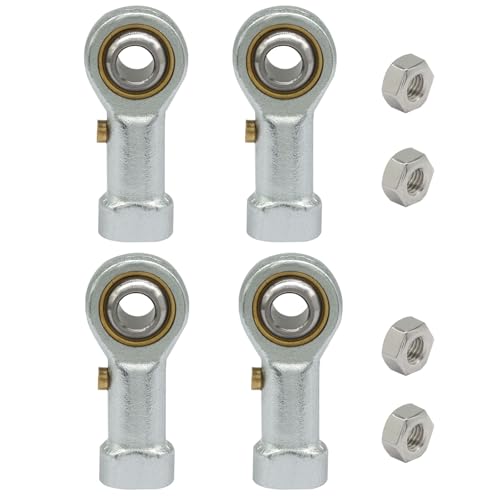
The Waziaqoc set combines alloy steel construction with a corrosion-resistant silver finish. It includes four bearings with a 1/4″ bore and 1/4-28 right-hand thread, plus jam nuts for secure assembly. It’s designed for quick, easy installation and broad compatibility with hydraulic cylinders, automation equipment, and power tools. Best for bulk projects where a balance of durability and cost-per-unit matters. Caution: verify fitment in tight spaces where nut clearance matters to avoid interference.
Buying Guide
Key purchase considerations for 1/4-28 heim joints include material quality, load capacity, and misalignment tolerance. For high-load environments, prioritize forged #45 steel bodies and hardened bearing steel balls, as seen in ZOWZEA, HiPicco, and Yeebyee options. If corrosion resistance is important, look for zinc-plated bodies or alloy steel with protective finishes like the Waziaqoc unit. For frequent maintenance or budget constraints, multi-pack options from uxcell or Yeebyee offer value without compromising essential strength. Always confirm bore size, thread type (1/4-28 RH), and the maximum angular misalignment that your system can tolerate. Consider jam nuts included versus needing separate hardware and ensure space around the joint allows full nut wrenching without collision.
Practical comparison questions
- Which option offers the highest misalignment tolerance? HiPicco CF4 (13.5 degrees).
- Which products emphasize corrosion resistance? uxcell and Waziaqoc.
- Which are best for bulk installations? Yeebyee and Waziaqoc offer multi-pack options.
- What should I inspect for longevity? Ball bearing material, body forging method, and protective plating.
- When is a jam nut included? ZOWZEA, HiPicco CF4, Yeebyee, and uxcell typically include jam nuts; verify per SKU.
Frequently Asked Questions
- What is the standard bore and thread size for these joints? Answer: 1/4-inch bore with 1/4-28 right-hand thread on the models shown.
- Are these suitable for outdoor use? Answer: Some finishes provide corrosion resistance, but prolonged exposure to harsh elements may require additional protection.
- How do I choose between single and pack options? Answer: Pick single bearings for a focused project; packs offer better value for multiple joints.
- Do all include jam nuts? Answer: Most shown options include jam nuts, but verify the SKU details before purchasing.
- What installation considerations matter? Answer: Ensure proper lubrication, alignment within the specified angular range, and clear nut access during maintenance.
- Can these bearings handle dynamic cyclic loads? Answer: They are designed for both static and dynamic loads; refer to static and dynamic load capacities listed for each model.