Clear, actionable guidance for buyers seeking portable gas cans with pumps. This guide highlights five top options suited for homeowners, boaters, farm workers, and DIY enthusiasts who need convenient fuel transfer on the go. Each entry notes who it’s best for and why, plus a practical limitation to consider. A quick summary table follows to compare core details at a glance.
Summary of selected products
- Scepter Duramax Flo ’N Go 14 Gallon Gas Caddy — Best for rugged terrains and large jobs.
- Scepter 14 Gallon Gas Caddy with Electric Pump — Best for quick, hands-free transfers.
- PAMBEE 15 Gallon Gas Can — Best for long trips and multiple vehicles.
- PeakPursuit 15 gal Gas Caddy — Best for siphon-friendly operation and light weight.
- Garvee 16 Gallon Gas Can with Manual Pump — Best for reliable manual pumping and durability.
Scepter Duramax Flo ’N Go 14 Gallon Gas Caddy

Best for heavy-duty use on farms, marinas, and large properties. This 53-liter fuel caddy features a wheeled frame with 6-inch wheels and a rugged top handle for off-road maneuverability. It supports gravity-flow and manual pump/siphon operation, giving flexibility when fueling from various elevations. The high-density polyethylene construction resists corrosion and denting, making it suitable for long-term outdoor use. A practical choice for users who regularly refuel multiple machines on uneven ground.
Who it’s best for: Farmers, boat owners, and maintenance crews who need a high-capacity, maneuverable fuel caddy that can handle rough terrain.
Why selected: Combines large capacity with two fueling modes and durable build, simplifying fuel handoffs on-site.
Limitation: Gravity-flow and siphon modes rely on positioning; choose this if you routinely elevate and transfer fuel to equipment above ground level.
Scepter Duramax Flo ’N Go 14 Gallon Gas Caddy, Gasoline Only, 2026 Version

Best for quick, controlled fueling with a built-in pump. This version emphasizes a larger 14-gallon capacity and a heavy-duty 6-inch wheel chassis. It provides gravity and siphon modes, plus a 10-foot hose for easy reach. The pump can be powered by an 8-AA battery setup or an optional AC cable, offering flexibility for remote sites or a workshop. Ideal for users who want fast transfers without lifting heavy cans.
Who it’s best for: Fleet managers, landscapers, and homeowners who value fast, controlled fuel transfers with a portable system.
Why selected: The combination of a long hose, multiple transfer modes, and a powered pump supports diverse fueling tasks.
Limitation: Battery or power source required for maximum flow; ensure you have spare batteries or access to power if you choose fast transfers.
PAMBEE 15 Gallon Gas Can
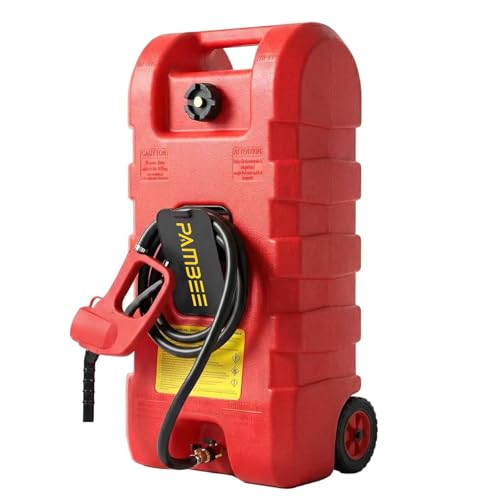
Best for long trips between refueling stops and multi-vehicle needs. This 15-gallon capacity container uses high-density polyethylene that resists rust, with a 10-foot hose made of automotive-grade rubber. It supports two operation modes, siphon and gravity, enabling a flow rate up to 3 GPM in siphon mode. Its top handle and 6-inch wheels aid transport across varied terrains. Suitable for boats, ATVs, and larger lawn equipment.
Who it’s best for: Individuals refueling multiple vehicles on a schedule or those needing a larger portable tank.
Why selected: Large capacity and dual-mode operation with a long hose help reduce refueling interruptions.
Limitation: Siphon speed depends on user input; aggressive pumping improves flow but requires effort.
Garvee 16 Gallon Gas Can With Manual Pump
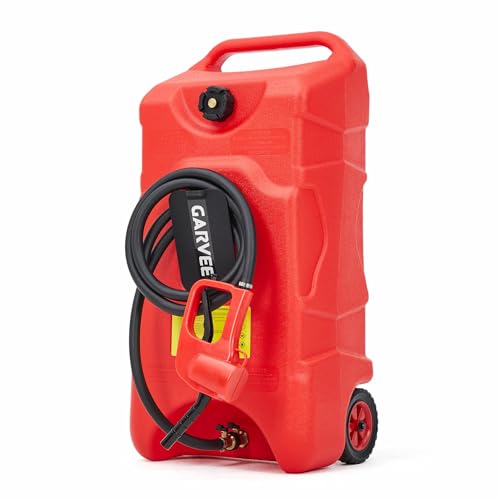
Best for rugged outdoor use and emergency fuel storage. Garvee’s 16-gallon can uses industrial-grade HDPE with reinforced walls for durability in extreme conditions. It includes dual shut-off valves and a vapor-tight seal to minimize spills, plus a manual transfer pump with a flexible hose and 360° nozzle for controlled pouring. The design emphasizes safety features like a child-resistant cap and anti-static grounding, making it suitable for home, garage, or worksite fuel handling.
Who it’s best for: Utility users needing dependable, spill-minimized manual pumping in challenging environments.
Why selected: Strong build and spill-control design with a practical manual pump makes it versatile for varied tasks.
Limitation: Manual pumping may be slower than electric pumps, especially for larger volumes.
Buying Guide
What capacity should you choose?
Capacity ranges from 14 to 16 gallons in these options. Higher capacity reduces frequent refills but adds weight and bulk. Consider your typical fueling session: one vehicle or several machines? If you refuel often, a 14-gallon with a pump is usually sufficient; for longer trips, a 15–16 gallon model may be more economical.
Do you need an electric pump or manual pump?
Electric pumps offer faster transfers and reduced effort, but require power or batteries. Manual pumps are reliable anywhere and don’t depend on electricity, but can be slower. Some models support both gravity/siphon modes as well as an optional electric pump.
Is siphon or gravity flow better for your setup?
Siphon mode is fast when you can lift the tank, suitable for ground-level transfers. Gravity flow works when the source is higher than the recipient, great for filling equipment on an elevated platform. A combination of modes provides the most versatility.
What safety features matter?
Look for leak-proof seals, dual shut-off valves, vapor-tight caps, and anti-static grounding. These features reduce spills during transfer and storage, enhancing workplace safety and minimizing waste.
Portability and terrain considerations
Wheels and a sturdy handle improve mobility across lawns, decks, or uneven surfaces. 6-inch wheels are common and balance payload with maneuverability. If you frequently move across gravel or dirt, prioritize models with robust wheels and chassis.
Maintenance and materials
High-density polyethylene (HDPE) is corrosion-resistant and durable. Check for UV resistance if you store cans outdoors. Regular inspection of hoses, valves, and seals helps prevent leaks and ensures a longer service life.
FAQ
- What size portable gas can is best for a single garage? A 14–15 gallon can is typically ideal for a single-facility setting, balancing capacity with manageable weight.
- Can I use any electric pump with these cans? Most pumps are designed for specific can adapters or hose connections; verify compatibility before purchasing to avoid fit issues.
- Is it safer to transport fuel cans with pumps attached? Yes, using a contained caddy with secure valves and hoses minimizes spills during transport.
- Do these cans work with diesel, gasoline, and kerosene? Many models specify compatibility with multiple fuels; confirm the intended liquid type and reuse guidelines for each model.
- Are there models with auto-stop features? Some electric pumps include auto-stop sensors to prevent overfilling, reducing spills and waste.
- What maintenance steps keep these cans safe? Regularly inspect hoses, seals, and caps; store upright to prevent leaks; keep the pickup area clean and dry.