Answering the buyer’s search, these trailer jack wheels support up to 2,000–3,000 lbs and offer dual or single wheels for stability on uneven ground. They’re suited for RVs, boats, and utility trailers, with options that emphasize ease of mounting, rust resistance, and smooth cranking. This guide highlights five top picks, explains who each product is best for, and compares lift ranges, wheel configurations, and installation methods.
| Product | Lift Range | Wheel Type | Best For |
|---|---|---|---|
| The Ultimate Trailer Jack | 12″ outer lift, 15.5″ top-crank | No wheel (no-crank variant included in design) | Heavy-duty, no-crank preferred users |
| Kohree 2000 lbs Trailer Jack | 26–38″ | Dual wheels | All-terrain, stable ground clearance |
| YOMILINK 2000 lbs Dual Wheel | 25.5–37.8″ | Dual wheels | Heavy-duty, bolt-on or weld-on mounting |
| VEVOR Trailer Jack with Wheel (Dual Wheel) | 15–27″ | Dual wheels | Precise positioning on boats and RVs |
| Torin 1000 lbs Trailer Jack with Wheel | 10.5–20.5″ | Single wheel | Compact, light-duty backup option |
The Ultimate Trailer Jack – 2000lb No-Crank Tongue Jack

The Ultimate Trailer Jack is designed for 2,000 lb lifting with a corrosion-resistant zinc-coated steel construction. It features a 12″ adjustable drop leg and an additional 15.5″ lift with a top-wind handle for precise height adjustment. This model emphasizes durability and ease of use, with roller bearings to reduce cranking effort. Best for trailers needing strong, rust-resistant components without added wheels in the base design.
Best for: Builders or owners prioritizing maximum stability and no-crank operation on heavier trailers. Caution: No wheel is included, which may limit ground mobility on soft surfaces.
Kohree 2000 lbs Trailer Jack with Dual Wheel

Kohree’s 2000 lb trailer jack combines heavy-duty steel construction with corrosion-resistant galvanization, thick tubes, and dual PP wheels for stability on soft or uneven surfaces. It supports a height range from approximately 26 to 38 inches and is compatible with various trailer tongues. Best for: trailer owners who need extra ground stability and faster lifting when using a cordless drill or hand crank.
Best for: Alleviating sinking on dirt or gravel, with dual wheels improving balance. Caution: Electric drill compatibility varies by model and requires compatible power.
VEVOR Trailer Jack with Wheel – Dual Wheel 2000 lbs
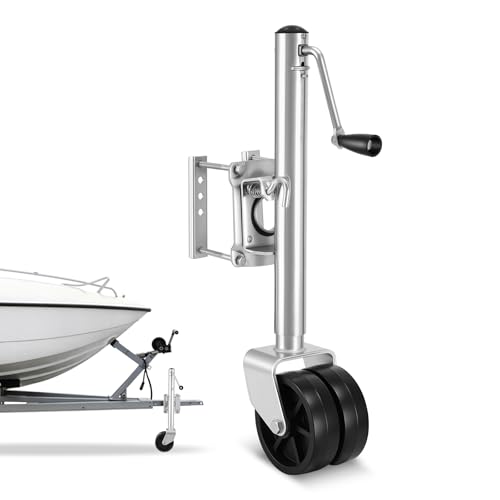
VEVOR’s 2,000 lb dual-wheel trailer jack emphasizes a broad lifting range (15–27 inches) and easy installation. The dual wheels enhance stability during positioning and alignment, making it a solid choice for RVs, boats, and utility trailers. Best for: users needing precise handling when docking or hitching in varied ground conditions.
Best for: Steady, controlled movement in challenging terrains. Caution: Dual wheels add width, which may affect narrow trailer tongues.
YOMILINK 2000 lbs Trailer Jack with Dual Wheel (Silver)

YOMILINK’s 2000 lb dual-wheel trailer jack offers a 25.5–37.8 inch lift range and is suitable for tongues from 3″ to 5″. It supports mounting via bolts or welding, and features galvanized inner and outer tubes with a heavy-duty carbon steel frame. Best for: heavy trailering setups requiring a long reach and strong corrosion resistance. Caution: Installation method (bolting or welding) should align with trailer tongue design and local regulations.
VEVOR Trailer Jack with Wheel – Single Wheel (12″ Lift)

VEVOR’s 12″ lift single-wheel jack supports up to 2,000 lbs with a robust, corrosion-resistant build. It is designed for easy installation and swivels to fold away when not in use. Best for: trailers that require a compact option with straightforward mounting and reliable strength. Caution: Single wheel can be less stable on very soft ground compared to dual-wheel models.
Buying Guide
Key factors to consider when selecting trailer jack wheels include lift range, wheel configuration, mounting method, and material quality. A dual-wheel setup generally offers better stability on soft or uneven surfaces, while a single wheel can save space and weight on smaller trailers. Check ground clearance and tongue compatibility (3″–5″ tongues are common). Assess corrosion resistance (galvanized or zinc-coated finishes perform best in harsh environments). If you need fast, hands-off lifting, consider models that accommodate cordless drills, but verify compatibility with your battery system.
Practical questions to guide your choice:
– Do you primarily trailer on soft ground or gravel, requiring dual wheels for stability?
– Is a bolted-on or weld-on mounting method more feasible for your trailer tongue?
– Do you prefer a no-crank operation or are you comfortable with a traditional hand crank?
– What is your trailer’s tongue width and lift needs across different trips?
– Will you benefit from a longer lift range to accommodate higher ground clearance?
Frequently Asked Questions
- What lift range is typical for trailer jacks with wheels? Most models offer roughly 10–27 inches of lift, with some extending to 37 inches for tall tongues.
- Are dual-wheel jacks more stable? Yes, dual wheels distribute weight more evenly and reduce sinking on soft ground compared to single-wheel designs.
- Can I install a trailer jack on any tongue? Install compatibility depends on tongue thickness and mounting method (bolted or welded). Always follow manufacturer guidelines and local codes.
- Is a no-crank trailer jack better? No-crank designs can expedite lifting but may limit fine height tuning versus a top-wind or side-wind crank.
- What maintenance is required? Regularly inspect for corrosion, ensure bolts are tight, lubricate moving parts, and store in a dry area when not in use.
- Do these jacks work with all trailer types? They are commonly used with RVs, boat trailers, and utility trailers; verify load capacity and tongue compatibility for your specific model.
Buying decisions should align with ground conditions, tongue dimensions, and the desired balance of lift range and stability. The products listed above provide a range of wheel configurations and mounting options to fit most common American trailer setups.