When you’re dealing with rust on metal frames, trailers, fences, or automotive parts, these no-sanding rust converters offer a fast, one-step solution. The best options convert rust directly into a paintable, protective layer without grinding or priming. This guide highlights five top products, explains who they’re best for, and compares key points to help you choose wisely. Ideal buyers include DIY homeowners, small shop mechanics, and outdoor equipment owners seeking durable, primerless rust protection.
| Product | Best For | Why It Stands Out |
|---|---|---|
| Cocomfix Ultra 2-in-1 Rust Converter Paint & Primer | DIYers who want one-step application | Direct-to-rust coating; heat-stable, peel-proof barrier |
| Duraxell 3-in-1 Rust Converter & Primer | Heavy use metal projects | Converts rust, primes, and seals in one step |
| NetLea 2-in-1 Rust Converter & Primer | Budget-minded DIYers | Two-in-one formula with no sanding required |
| Rust-Oleum Stops Rust Reformer Spray | Fast, spray-on rust reforming | Instant rust to paintable surface in a spray |
| DWIL Rust Converter and Metal Primer 2-in-1 | Tough surfaces and hard-to-reach areas | High-flow liquid formula with capillary action |
Ultra 2-in-1 Rust Converter Paint & Primer
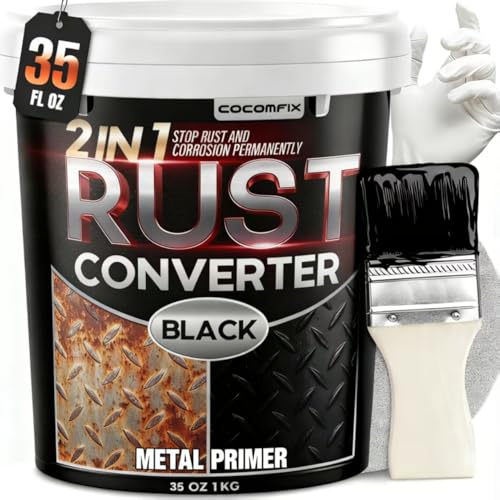
Best for: DIY enthusiasts who want a single-step solution on vehicles, frames, or trailers. This cocomfix product converts rust into a durable, black coating that acts as both a converter and primer, enabling direct painting over rust without sanding. It’s designed to handle heat up to 350°F and resists salt, UV, and moisture exposure, making it suitable for undercarriage and chassis components.
Why selected: It combines rust conversion with a peel-proof adhesion and a heat-stable film, reducing prep time and improving longevity in harsh environments. The single-coat claim helps save time on larger projects.
Caution: Performance may vary with severely pitted metal; thoroughly remove loose scale before applying for best results.
Rust-Oleum Stops Rust Reformer Spray

Best for: Quick, contact-surface rust reform on smaller parts or intricate shapes where brushing is impractical. The spray formulation allows fast coverage with less manual prep.
Why selected: It instantly converts rust to a protected paintable surface, minimizing prep time. The product is suitable for black, matte finishes and supports later topcoats after curing.
Caution: The label emphasizes proper ventilation and drying times before topcoating; ensure even coats to avoid uneven texture on larger pieces.
Duraxell 3-in-1 Rust Converter & Primer

Best for: Automotive frames, trailers, fencing, and outdoor metal exposed to moisture and salt. This product promises year-round protection by chemically neutralizing rust and sealing out moisture.
Why selected: It’s an all-in-one solution that claims to stop rust at the source and create a long-lasting barrier, reducing the need for multiple products on larger jobs.
Caution: It requires removing loose debris before application; application times may vary with temperature and surface condition.
NetLea 2-in-1 Rust Converter & Primer

Best for: DIYers seeking an affordable, no-sanding-needed rust solution for cars, fences, and tools. It forms a protective, matte black coating after conversion.
Why selected: The 2-in-1 formula combines rust converter and primer in one step, saving time on prep and priming while providing durable corrosion protection. It’s suitable for multiple metal surfaces.
Caution: Heavily rusted or flaking areas may require twoThin coats; ensure adequate drying time between applications.
DWIL Rust Converter and Metal Primer 2-in-1

Best for: Tough surfaces and hard-to-reach areas on car chassis, truck frames, fences, and equipment where capillary action is beneficial for deep rust penetration.
Why selected: Its high-flow, liquid formula is designed to reach microscopic pores and tight crevices, converting rust internally and forming a protective barrier without sanding. The product emphasizes 2-in-1 primer and converter capabilities.
Caution: Work in a well-ventilated area and apply in thin coats for best penetration; curing may take longer in cooler conditions.
Buying Guide: Key Considerations For No-Sanding Rust Converters
- Application method: Choose between brush, roller, or spray formats depending on the area size and detail. Spray options suit tight or intricate parts, while brushes work well for flat surfaces.
- Heat and chemical resistance: For automotive or outdoor use, select products that withstand heat, UV exposure, salt, and chemical exposure to extend life.
- One-step vs. two-step: Some products combine rust conversion and primer in one; others require a separate topcoat. Consider project scope and finish needs.
- Coverage and dry time: Look for how many square feet a container covers and how quickly it cures to avoid weathering during application.
- Surface compatibility: Most rust converters work on steel, iron, and similar metals; check for compatibility with aluminum or galvanized surfaces if applicable.
- Best-for scenarios: If you’re restoring heavy equipment, a robust, long-lasting barrier matters more than ease of application; for quick fixes, a spray-on reformer may be ideal.
Frequently Asked Questions
- What is a rust converter and how does it work? A rust converter chemically reacts with rust to form a stable, black protective layer that can be painted over, eliminating the need for sanding in many cases.
- Can I apply these products directly onto rusty surfaces? Yes, most are designed for direct-to-rust application after removing loose debris, though heavily pitted areas may benefit from careful preparation.
- Do I still need a topcoat after using a rust converter? It depends on the product and project; some allow direct painting, while others recommend a topcoat for extra protection.
- How long does curing take? Cure times vary by product and temperature; many products reach touch-dry within 15-60 minutes, with full cure over 24 hours.
- Are these safe for outdoor use? Many are formulated to resist UV and moisture, but follow manufacturer directions for environmental exposure and ventilation during application.
- Is sanding ever required with these products? In most cases, sanding is not required, but removing loose rust and debris improves adhesion and coverage.