Locate a reliable, easy-to-read tire pressure gauge for quick checks on the road. This guide highlights five large-dial or clearly readable gauges suitable for cars, trucks, motorcycles, and RVs. Ideal buyers include DIY vehicle owners, fleet drivers, and camping/travel enthusiasts who value quick, accurate readings in low light or bright sun. The selections balance dial visibility, construction quality, and user-friendly features to fit varied needs and budgets.
| Product | Range | Type | Best For |
|---|---|---|---|
| ETENWOLF Tire Pressure Gauge (0-75 PSI) | 0-75 PSI | Analog with Large Glow Dial | Night reads, basic home uses |
| ETENWOLF T300 Digital Tire Pressure Gauge (3-200 PSI) | 3-200 PSI | Digital w/ AI Thermal Compensation | All-season accuracy, extreme temps |
| AstroAI Digital Tire Pressure Gauge (0-150 PSI) | 0-150 PSI | Digital w/ Backlight LCD | Dark garages, multi-unit reads |
| JACO ElitePro Tire Pressure Gauge | 0-100 PSI | Mechanical Brass, No Battery | Rugged feel, no batteries |
| TireTEK ANSI Certified Analog Gauge | ~10-75 PSI (typical) | Analog with Extended Chuck | Mechanic-grade durability |
ETENWOLF Tire Pressure Gauge 0-75 PSI

Best for budget-conscious users who want a large glow dial for quick readings in low light. This analog gauge is manually calibrated to ANSI B40.1 Grade A (±1% of span) and covers common vehicle needs from cars to light trucks and RVs. The prominent dial is designed for easy visibility in the dark, aiding drivers who frequently check tire pressure before long trips. A potential limitation is the absence of digital units or battery-less digital features, which may matter for those who prefer multiple measurement scales.
- Calibrated to ANSI B40.1 Grade A (±1%)
- 0-75 PSI range suitable for most passenger vehicles
- Large glow dial for night readability
- No battery required
ETENWOLF T300 Digital Tire Pressure Gauge

This digital gauge covers a broad range (3-200 PSI) with ANSI B40.7 Grade 2A accuracy (±1 PSI). It uses an AI-assisted thermal compensation system to maintain accuracy in extreme temperatures, from cold winter mornings to hot summer days. It’s best for drivers who routinely check higher pressures or operate trucks and SUVs. A caveat is that the Presta valve adapter is not included, so cyclists using Presta valves will need to purchase one separately.
- Calibration to ANSI B40.7 Grade 2A (±1 PSI)
- Wide range suitable for cars, trucks, and SUVs
- Thermal compensation for extreme temperatures
- Presta valve adapter sold separately
AstroAI Digital Tire Pressure Gauge
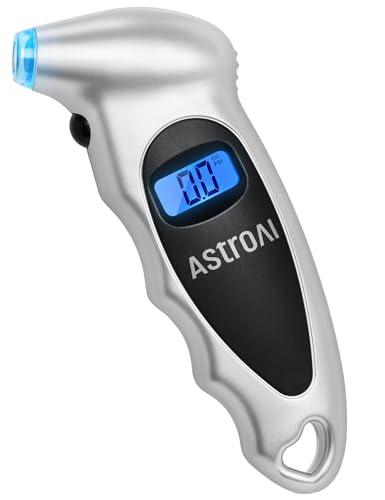
Best for drivers who value a backlit display and easy unit switching. This gauge reads 0-150 PSI with ANSI B40.7 ±1 PSI accuracy. It features a bright backlit display and a nozzle light for valve stem visibility in dim environments. Four measurement units (PSI, Bar, Kgf/cm², KPa) are accessible with a single button, making it versatile for households with multiple vehicles and regional preferences. The device is best avoided by users who require battery-free, mechanical operation in extreme environments, though its digital performance offers clear advantages in visibility.
- Backlit LCD and nozzle light for dark environments
- 0-150 PSI with ±1 PSI accuracy
- Multiple units: PSI, Bar, Kgf/cm², KPa
- One-button unit switching
JACO ElitePro Tire Pressure Gauge
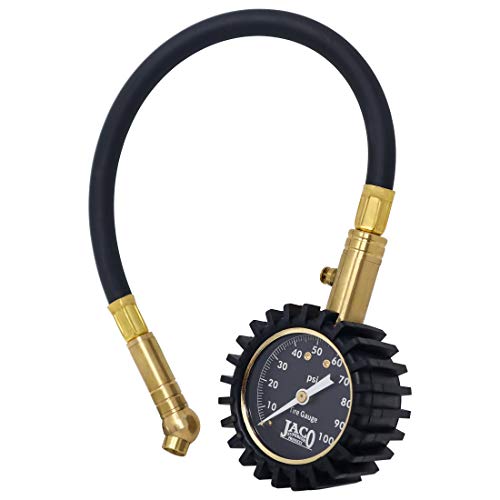
Best for professionals and serious DIYers who want a rugged, battery-free gauge with a durable brass core and a protective guard. The ElitePro is calibrated to ANSI standards (±1.5%) and accommodates up to 100 PSI. It features a robust 10-inch, fully rotational, leak-proof HybridFlex hose and a 360-degree swivel chuck for easy valve access from any angle. A built-in air bleeder valve helps reduce overinflation in real time. Choose this if you need a shop-grade tool that withstands drops and heavy use. It may feel heavier than pocket models and lacks digital readouts for quick glance readings.
- ANSI-calibrated within ±1.5%
- Solid brass core with shock-resistant guard
- HybridFlex hose and 360° swivel chuck
- Built-in air bleeder valve
Buying Guide
What type should you choose?
- Analog large-dial gauges are dependable, battery-free, and easy to read in bright or dim light thanks to glow dial features. They are ideal for quick weekend maintenance or as a simple backup gauge.
- Digital gauges offer higher precision, backlight visibility, and multiple units. They suit users who check tire pressures frequently, drive in variable climates, or need readings in different measurement systems.
- Durability matters. Mechanically robust gauges with brass cores and protective guards endure drops and harsh environments; hoses and swivels also affect ease of use over time.
- Calibration and accuracy standards (ANSI B40.1 or B40.7) indicate reliability. Higher-grade gauges may have tighter tolerances but can cost more.
- Compatibility considerations include valve types (Schrader vs. Presta) and whether an adapter is included or required.
What to look for when buying
- Measurement range that covers your vehicles’ typical pressures (cars ~25-40 PSI, trucks and SUVs higher ranges).
- Readability: dial size, contrast, and glow features or backlight for low-light conditions.
- Durability: build materials (brass, stainless steel) and protective housings.
- Ease of use: one-handed operation, no batteries (for analog), or quick unit switching (for digital).
- Accessories: included caps, adapters, or bleeder valves that extend usability.
Frequently Asked Questions
- What is a large dial gauge best used for?
– Large dial gauges provide quick, at-a-glance readings and are often easier to use in dim conditions without battery concerns. - Do digital gauges require batteries?
– Yes, most digital gauges require batteries, but they offer backlighting and multi-unit displays for convenience. - Is ANSI rating important?
– ANSI ratings indicate standardized accuracy. Higher grades imply tighter tolerances and more reliable readings. - Can I use a tire pressure gauge on bicycles?
– Some gauges are compatible with cycle valves; check product specs for Presta/Schrader compatibility and adapters if needed. - Should I choose a gauge with a bleeder valve?
– A built-in bleeder helps fine-tune overinflated tires without removing the gauge, useful for precise adjustments.