Finding reliable cellular service on the road is essential for travelers, remote workers, and families in RVs. The right RV cell signal booster can improve voice quality, data speeds, and hotspot stability across multiple carriers. Below is a curated guide to five top boosters that support 4G LTE, 5G, and multiple US networks. Each product includes core specs, expected coverage, and compatibility notes to help you compare options for your vehicle.
Summary of chosen products:
| Product | Brand | Key Benefit | Typical Use |
|---|---|---|---|
| Cell Phone Booster for Truck RV Vehicle | SignalBrick | Up to 5–8 miles range; 5-band support | Truck/RV, multi-user |
| HiBoost Cell Phone Booster Kit for RV 3.0 | HiBoost | Max gain up to 50dB; wide coverage | RV, camper, van, trailer |
| RV Cell Phone Booster for Car/Truck | PRACOA | Up to 5–8 miles; 100x signal improvement | RV, car, truck |
| Cell Phone Booster for RV Overland | GLYXIO | 5–8 miles range; 100x stronger | Truck, RV, off-road |
| HiBoost RV Travel 2.0 Booster | HiBoost | Supports all major US carriers; adaptable indoor antenna | RV, camping, travel |
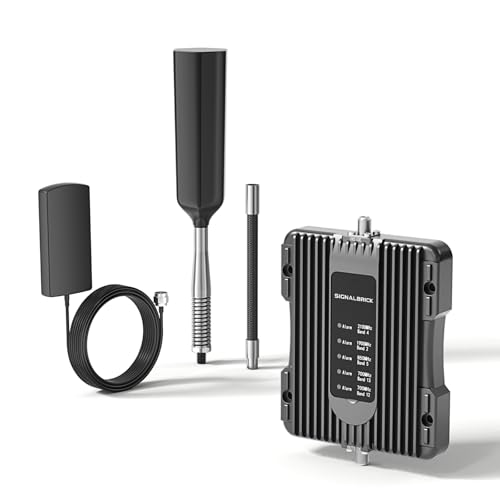
SignalBrick Truck and RV Cell Signal Booster

The SignalBrick five-band booster targets 3G, 4G LTE, and 5G bands, delivering enhanced voice and data across Band 12/17, 13, 5, 4, and 2/25. It is designed for trucks and RVs with multi-user compatibility, allowing smartphones, tablets, and data modems to connect concurrently. Users can expect improved call reliability, faster data speeds, better streaming, and extended hotspot performance, with a practical range of up to 5–8 miles in suitable outdoor signal conditions. Before purchasing, verify your outdoor signal strength and band compatibility.
HiBoost 3.0 RV Booster Kit

HiBoost’s Travel 3.0 RV Max kit is engineered for Class A, B, and C RVs with up to 50dB gain, providing broader coverage for vans, trailers, buses, and even houseboats. It supports multi-user scenarios across Band 12/17, 13, 5, 4, 25/2 and is FCC-certified. An optional 180-degree adjustable folding bracket enables versatile mounting on poles, ladders, roofs, or T-slot racks, helping to achieve the best signal direction while traveling or parked. The system is designed for remote work, streaming, and navigation with more reliable cellular connectivity.
PRACOA RV Car Cell Phone Signal Booster
PRACOA’s vehicle booster supports 5G, 4G LTE, and 3G with Bands 2/4/5/12/13/17/25/66, making it compatible with major U.S. carriers. It is designed for trucks, RVs, boats, and other mobile platforms, enabling up to 5–8 miles of coverage and up to 100x signal improvement. It features automatic gain control (AGC) for stable performance and includes indicators to monitor connection status. The device emphasizes broad device compatibility and multi-user operation for road trips and camping.
GLYXIO RV Truck Car Signal Booster

GLYXIO’s five-band booster is built for trucks, RVs, and overland adventures, supporting Verizon, AT&T, T-Mobile, and other major carriers with 5G/4G LTE. It claims up to 5–8 miles of coverage and 100x signal enhancement to reduce dropped calls and improve data speeds. The kit is designed for use in remote or wooded areas and includes compatibility guidance for optimal performance. A key note is to confirm outdoor signal strength prior to use to achieve best results.
HiBoost RV Travel 2.0 Booster Kit

HiBoost’s Travel 2.0 booster focuses on all U.S. carriers, delivering stronger signals for voice calls and data across 4G and 5G networks. The kit includes a flexible indoor antenna with a 13-foot cable, allowing placement for optimal coverage inside the RV. It supports Band 12/13/5/25-2/4, making it suitable for varied regional networks and multi-user scenarios during RV trips and camping. The system emphasizes ease of placement and adaptability for different RV layouts.
Buying Guide
- Carrier coverage and bands: Verify which bands your devices use (e.g., 12/13/17/5/4/2/25) and ensure the booster supports those bands for all intended carriers.
- Range and power: Boosters claim ranges from 5 to 8 miles. Consider your typical travel routes, campsites, and remote areas to choose a model with sufficient gain and coverage for your needs.
- Multi-user support: If multiple devices will connect simultaneously (phones, tablets, portable hotspots), select a model designed for multi-user operation without performance drops.
- Installation flexibility: Look for adjustable mounts, weather resistance, and long antenna cables to fit your RV’s layout and mounting options (roof, ladder, pole, or T-slot racks).
- Outdoor signal prerequisites: Most boosters require a baseline outdoor signal strength (often around -110 dBm or better). Check your location with a signal meter or app before choosing.
- FCC certification and safety: Choose FCC-certified models that meet safety standards and have automatic gain control to prevent self-oscillation and battery drain.
- Portability vs. fixed setup: Decide if you need a portable kit for multiple vehicles or a fixed system tailored to a single RV. Portable kits offer flexibility for seasonal travel or towables.
- Ease of use and indicators: Simple LED indicators and clear user manuals help ensure proper operation and troubleshooting in remote locations.
- Compatibility notes: Some boosters require specific vehicle types (truck, RV, or car) or mounting considerations. Read the product notes for any restrictions.