The right tire pressure gauge helps you maintain optimal inflation, improve fuel efficiency, extend tire life, and enhance overall driving safety. This guide highlights five highly regarded models that balance accuracy, build quality, and ease of use for American drivers. Each entry includes a direct link to Amazon, a quick visual, and essential features to compare at a glance.
| Product | Brand | Pressure Range | Key Feature |
|---|---|---|---|
| ETENWOLF T300 Digital Tire Pressure Gauge | ETENWOLF | 3-200 PSI | ANSI B40.7 Grade 2A accuracy, replaceable batteries |
| ETENWOLF 0-75 PSI Digital Gauge | ETENWOLF | 0-75 PSI | Large glow dial, ANSI B40.1 Grade A |
| JACO ElitePro Digital Tire Pressure Gauge | JACO Superior Products | 0-200 PSI | Dual sensors, professional ANSI 2A accuracy, built-in bleeder |
| AstroAI Digital Tire Pressure Gauge | AstroAI | 0-150 PSI | Backlit LCD, four units, Presta valve adaptor |
| Milton S-921 Pencil Gauge | Milton | 5-50 PSI | Built-in deflator valve, USA-made |
Note: All models support common vehicle tires, with some offering features tailored for low-light use, heavy-duty performance, or multifunction readings. When choosing, consider range needs, display readability, and any required adapters or deflation capabilities.
ETENWOLF T300 Digital Tire Pressure Gauge

The ETENWOLF T300 is a versatile digital gauge calibrated to ANSI B40.7 Grade 2A with plus-minus 1 PSI accuracy. It covers a broad range from 3 to 200 PSI, making it suitable for cars, trucks, and other vehicles. The device includes an AI-assisted thermal compensation system to maintain accuracy in extreme temperatures (-4°F to 130°F). While compatible with standard Presta adapters when needed, the specified precision applies to automotive tires, and the unit operates reliably across weather conditions. Its rugged construction and replaceable AAA batteries offer long-term usability in home garages or professional settings.
ETENWOLF Tire Pressure Gauge For Cars 0-75 PSI

This model targets everyday car maintenance with a 0-75 PSI range and a large glow dial for visibility in low light. Calibrated manually to ANSI B40.1 Grade A (plus-minus 1%), it’s well-suited for typical passenger vehicles, motorcycles, and light-duty trucks. The glow dial simplifies nighttime checks, while the compact form factor makes it easy to store in a glove box or toolbox. For drivers who need a straightforward, dependable gauge without extra frills, this ETENWOLF offers solid performance at a fair price point.
JACO Superior ElitePro Digital Tire Pressure Gauge

The JACO ElitePro delivers professional-grade accuracy up to 200 PSI with dual pressure sensors and ±0.50% full-scale precision. It features a robust, brass-and-steel build, a 10″ fully rotational HybridFlex hose, and a 360-degree swivel air chuck. A built-in bleeder valve enables real-time pressure relief without resetting the display, which is especially useful for achieving precise inflation on cars, trucks, motorcycles, and trailers. This gauge is designed for users who require a shop-grade tool in a portable form, offering durable performance in demanding environments.
JACO ElitePro Digital Tire Pressure Gauge – 100 PSI
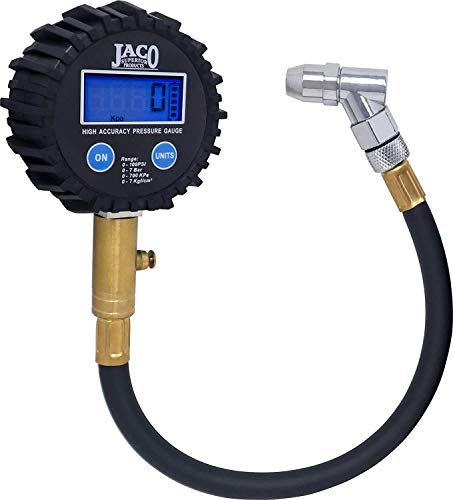
This variant offers professional-grade accuracy up to 100 PSI, with the same rugged build and features as the ElitePro line. It relies on ANSI 2A-calibrated sensors, providing readings with about ±0.50% FS precision and a 0.10 PSI readout resolution. The gauge includes a 10″ HybridFlex hose and a full-rotation chuck, plus an integrated bleeder valve to fine-tune inflation. It’s suitable for enthusiasts and professionals who work with a diverse fleet of vehicles, from sedans to light trucks.
Milton S-921 Pencil Tire Pressure Gauge

The Milton S-921 is a classic pencil-style gauge designed for reliability and simplicity. It measures PSI from 5 to 50 and kPa from 40 to 350, offering straightforward, sturdy performance. Made with machined brass components, it is manufactured in the USA and includes a built-in deflator valve for quick release of air. This model appeals to users who prefer a traditional, no-frills gauge with dependable accuracy for routine tire checks.
Buying Guide: Key Purchase Considerations
When selecting a tire pressure gauge, consider the following factors to match your needs:
- Accuracy and range: Look for gauges with industry-standard calibration (ANSI/UL or similar) and a range that covers your vehicle type. Digital models often offer higher precision and easier readability in low light.
- Display and readability: Backlit displays or large glow dials help in dim conditions. Consider the visibility of the scale and the clarity of unit indicators (PSI, kPa, Bar).
- Build quality: Metal construction, durable hoses, and protection against drops extend lifespan. Brass and steel components tend to last longer in rugged environments.
- Ease of use: Features such as zero-lock, real-time bleeder valves, and swivel chucks reduce hassle when inflating tires at home or on the road.
- Adapters and accessories: Some models include Presta adapters, deflator valves, or additional nozzles—useful for bicycles or specialized tires.
- Portability and storage: Compact designs fit glove boxes or toolkits for spontaneous checks during trips.
- Power source and maintenance: Digital gauges require batteries; check battery replacement availability and battery life expectations.
- Use case: Casual home use versus professional workshop work may justify different price points and feature sets.
In summary, for everyday driving, a gauge with a clear display, reliable accuracy, and a comfortable hose is ideal. For enthusiasts or professionals managing a variety of vehicles, models with dual sensors, higher max PSI, and a robust build may provide better value over time. Always verify the gauge’s calibration history when possible to ensure consistent performance.