For LiFePO4 battery systems, choosing the right solar charge controller is essential to maximize lifespan, safety, and performance. This guide highlights five top-rated controllers that support LiFePO4, AGM, Gel, and Flooded batteries, with a focus on LiFePO4 compatibility, efficiency, and rugged design. Each product below includes core features, ideal use cases, and practical considerations for RVs, boats, cabins, and off-grid setups.
Summary of selected products:
- Renogy Wanderer Li 30A 12V PWM – Negative Ground, LiFePO4 compatible, compact with protections.
- SOLPERK MPPT 10A 12V – High efficiency MPPT with robust IP65 housing and wide battery support.
- LNEX Solar Charge Controller 20A – Thin, waterproof PWM with LCD display and memory function.
- Voltset MPPT 10A – IP65 waterproof, 12V system, efficient MPPT tracking for up to 130W panels.
- SUNER POWER 30A MPPT – 12/24V operation, up to 99% tracking efficiency with temp sensor.
Renogy Wanderer Li 30A 12V PWM Controller

The Renogy Wanderer Li 30A PWM controller is designed to support LiFePO4, sealed, gel, and flooded batteries. It uses a 4-stage PWM charging approach (Bulk, Boost, Float, Equalization) to optimize charging cycles for longevity and performance. Built-in safeguards protect against reverse polarity, overcharging, overload, and short circuits. The compact, IP32-rated housing supports outdoor use with corrosion resistance, making it suitable for RVs, boats, and off-grid deployments where space is at a premium.
SOLPERK MPPT 10A 12V Solar Charge Controller
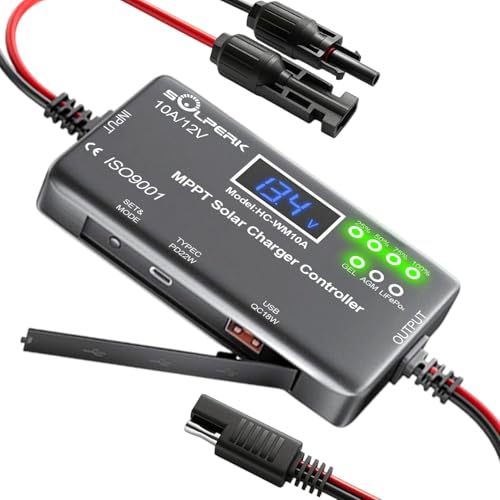
SOLPERK offers MPPT technology with up to 99% conversion efficiency, translating to higher energy harvest versus PWM options. It supports a wide range of battery chemistries, including LiFePO4, and includes eight safety mechanisms (overcharge, over-discharge, overload, short circuit, reverse connection). The rugged ABS housing with IP65 rating provides durable weatherproofing for outdoor installations, and its compact form fits into limited spaces in RVs or boats.
LNEX Solar Charge Controller 20A PWM

LNEX’s 20A PWM model emphasizes a slim, waterproof design, enabling deployment in tight spaces while maintaining performance. It features a 5-stage PWM charging profile (Soft Start, Bulk, Absorption, Float, Equalization) to extend battery life, plus an LCD display and LED indicators to monitor real-time current and voltage. The IP65-rated enclosure protects internal components from water spray and dust, making it well-suited for outdoor use on RVs or marine installations.
Voltset MPPT Solar Charge Controller 10A

Voltset’s 10A MPPT controller is designed for 12V systems and up to 130W panels, delivering faster charging with improved efficiency over PWM. It supports LiFePO4, AGM, GEL, and other 12V batteries. The IP65 waterproof rating ensures reliable outdoor operation, and its compact footprint makes it a practical choice for small cabins, campers, or trailers where space and weather exposure are considerations.
SUNER POWER 30A MPPT Solar Charge Controller

The SUNER POWER 30A MPPT controller features advanced MPPT tracking for up to 99% efficiency and robust 360W (12V) / 720W (24V) charging capability. It supports LiFePO4, AGM, Gel, and Flooded batteries and is equipped with a temperature sensor to optimize charging across changing conditions. With a durable construction and a focus on high-performance tracking, it suits larger off-grid systems or more demanding shore power setups in RVs, boats, or remote cabins.
Buying Guide
Key considerations when selecting a solar charge controller for LiFePO4 and related battery chemistries:
- Battery chemistry compatibility: Ensure the controller explicitly supports LiFePO4 (LFP) alongside other chemistries you use. Some PWM models target lead-acid by default and may require compatibility checks.
- Charge method and stages: Look for PWM versus MPPT, and the number of charging stages (commonly Bulk, Absorption, Float, and sometimes Equalization). MPPT can provide higher efficiency in larger or partially shaded systems.
- Voltage and current ratings: Match the controller’s operating voltage (12V/24V) and current rating (amps) to your panel array and battery bank size. Oversizing helps handle peak sun or future expansion.
- Protection features: A robust controller should include reverse polarity, overcharge/over-discharge protection, short-circuit protection, and environmental sealing (IP65 or better) for outdoor use.
- Display and monitoring: LCDs or app-based monitoring help track real-time voltage, current, and charging status. Memory functions and data logging can be valuable for long-term performance analysis.
- Physical fit and installation: Consider size, mounting options, and enclosure ratings if you have limited space or exposure to weather. Slim or compact designs can simplify installation in tight compartments.
- Temperature management: Temperature sensors or adaptative charging curves help prevent overheating and extend battery life, especially for LiFePO4 in hot climates.
- System scale: For small setups (up to about 100W panels), PWM controllers may be sufficient; for larger arrays, MPPT controllers typically deliver better energy harvest and faster charging.
Practical installation notes:
- Place the controller in a dry, ventilated area and avoid direct exposure to water spray unless the unit is rated IP65 or higher.
- Follow manufacturer wiring diagrams to connect panels, battery banks, and any loads correctly. Incorrect polarity or wiring can damage components.
- Use proper sizing for cables to minimize voltage drop, especially for longer runs between panels and the controller.
In summary, the five models above offer a range of PWM and MPPT options with LiFePO4 compatibility, making them suitable for RVs, marine adventures, and off-grid installations. Consider your battery type, system size, climate, and monitoring needs to pick the best fit for your setup.