Answering a common buyer question: the best auto glass reflective films provide daytime privacy, heat rejection, and UV protection without expensive window replacements. This guide compares five top options suitable for cars, homes, and offices. Each pick is evaluated for who benefits most, installation notes, and practical limits to help you choose confidently.
| Product | Best For | Key Benefit |
|---|---|---|
| KESPEN Window Privacy Film One Way Reflective (35.4″ x 6.5′) | Home or Office Privacy, Daytime Use | High UV Block, glare control, heat reflection |
| Upgraded One Way Window Privacy Film (17.5″ x 78.74″) | Hobby windows, smaller panes, DIY setups | 1-inch backing grids for easy cutting, daytime privacy |
| JNK NETWORKS Reflective Car Window Tint Film (40″ x 10′) | Vehicles needing strong heat/UV protection | High infrared/UV reduction, multiple color/size options |
| KESPEN Window Privacy Film One Way Daytime Privacy (17.5″ x 6.5′) | Compact panels and partitions | Daytime privacy, UV block, energy savings |
| TNJPSEK HUD Reflective Windshield Film (4.7″ x 3.5″) | Head-up display transparency and glare reduction | Bubble-free electrostatic adhesion, reusable |
KESPEN Window Privacy Film One Way Reflective (35.4″ x 6.5′)
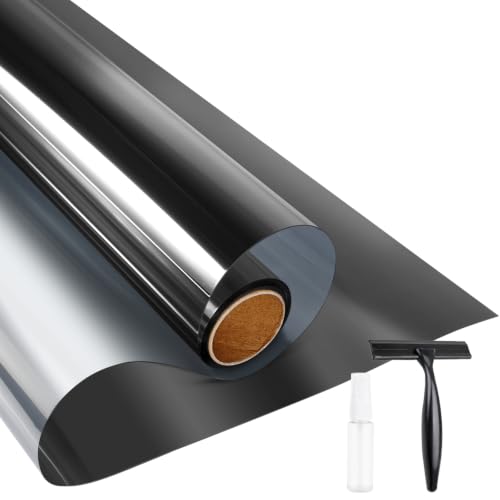
The product offers daytime privacy through a mirror-like effect, with 82% infrared and 90% UV blocking. It also provides heat control by reflecting heat away from interiors, aiding energy savings. Best for mid-size windows in homes or offices seeking daytime privacy without adhesive.
Who it’s best for
- Home offices and living rooms needing daytime privacy.
- Rooms with strong daylight where glare reduction helps comfort.
Limitation: Privacy at night requires drawing curtains since the mirror effect may disappear when interior lighting is brighter than exterior lighting.
Upgraded One Way Window Privacy Film (17.5″ x 78.74″)

Reflective film designed for easy DIY installation with 1-inch backing grids to simplify cutting. Emphasizes daytime privacy with a mirror-like exterior when daylight is stronger outside. Notable for energy savings through heat rejection and its removable backing for temporary privacy needs.
Who it’s best for
- Renters or short-term installations needing a removable solution.
- Windows with irregular shapes where easy cutting matters.
Limitation: Privacy can wane at night; plan to cover windows after dark for consistent privacy.
KESPEN Window Privacy Film One Way Daytime Privacy (17.5″ x 6.5′)
This non-adhesive reflective film blocks 82% of infrared rays and 90% of UV rays, delivering noticeable glare reduction and energy savings. It supports daytime privacy with a mirror effect. Best for partitions or large windows in sunny rooms.
Who it’s best for
- Home or office spaces facing direct sun exposure.
- Situations where a non-adhesive solution is preferred for easy removal.
Limitation: Like other daytime-only films, night privacy relies on window coverings.
TNJPSEK HUD Reflective Windshield Film (4.7″ x 3.5″)

Designed for HUD visibility, this reflective film provides a bright, sharp projection on 3–5 inch HUD and GPS displays with a reusable electrostatic design. It offers a practical solution for drivers who want glare reduction without adhesive mess.
Who it’s best for
- Drivers using HUD or GPS speedometers in bright daylight.
- Those who prefer reusable, bubble-free installation.
Limitation: This product is specific to HUD display protection and may not provide full home or office privacy compared to larger window films.
Buying Guide: Key Purchase Considerations
- Privacy needs: Do you want daytime privacy only or 24/7 privacy? Daytime-only films rely on mirror effects that fade with interior lighting.
- Surface compatibility: Are you applying to car windows, home windows, or office partitions? Film sizes and backing grids affect fit and installation effort.
- UV and glare reduction: Look for UV blocking percentages (common targets are 82% infrared and 90% UV) to protect interiors and skin.
- Heat control and energy savings: Reflective films can reduce heat transmission and help manage cooling costs; confirm estimated heat rejection capabilities.
- Installation method: Adhesive versus static cling affects removal, reusability, and ease of application. Non-adhesive films are easier to remove but may have different durability profiles.
- Maintenance and durability: Consider thickness (mil) and backing design for durability against scratching and wear in sunlit areas.
- Night-time considerations: If privacy at night is critical, plan for curtains, blinds, or another barrier in addition to the film.
How to choose by scenario
- For rental spaces or easy removal: non-adhesive/static cling options are preferable.
- For vehicles requiring strong heat and UV blocking: thicker, higher IR/UV reduction films perform best.
- For offices with large daylight exposure: films with high glare control and substantial visible light transmission maintain view while reducing glare.
Installation tips
- Measure windows accurately before selecting film sizes to minimize cutting and waste.
- Follow manufacturer guidelines for surface preparation and cutting; use grid backing when available to simplify fitting.
- Avoid installing in extreme heat or on dirty surfaces to reduce air bubbles and adhesion issues.
FAQ
- Q: Do these films completely block heat? A: They reduce heat transmission but performance varies by product and window type; higher infrared rejection generally yields better cooling effects.
- Q: Can I reuse non-adhesive films after removal? A: Some films permit reuse if cleaned and reapplied carefully, especially electrostatic types.
- Q: Will the privacy mirror work at night? A: The mirror effect depends on lighting balance; nighttime interior light can reduce the mirror, increasing visibility from outside.
- Q: Are these safe for home interiors? A: Most films include UV blocking to protect furniture and flooring from fading; check product specifics for each option.
- Q: Do these films require professional installation? A: Many are DIY-friendly, especially static cling and grid-cut designs, but some projects benefit from professional fitting for precision.
- Q: Do any films affect HUD or GPS readability? A: Reflective HUD films are designed to support projection clarity; adhesive films for windows should not impact HUD readability when applied to standard automotive glass.