Get reliable power in minutes with a 12V/24V booster starter that fits your needs. This guide highlights five strong options, explaining who each is best for and why. Use this to compare performance, safety features, and suitability for different vehicle types. The top picks cover everything from compact, portable units to heavy‑duty machines capable of diesel engines. Ideal buyers include daily commuters, outdoor enthusiasts, fleet managers, and workshop professionals seeking quick, safe starting power in medical or emergency situations.
The following table summarizes the selected products, focusing on who they’re best for and their standout strengths.
| Product | Best For | Key Strength |
|---|---|---|
| Clore Automotive Jump-N-Carry JNC1224 | Roadside helpers and DIY mechanics | High peak power in both 12V and 24V modes; long 46″ cables |
| FlyAuto 2800A/1400A Heavy Duty | Heavy-use scenarios and diverse vehicle fleets | Strong peak and instant output across many vehicle types |
| Clore Automotive Truck PAC ES1224 | Trucks and serious work vehicles | 60″ heavy cables; robust 12/24V operation |
| YESPER 6000A Jump Starter | Extreme cold starts and large engines | High peak current with auto 12/24V detection |
| Primedura 30,000A 1S Startup | Industrial and diesel engines | Massive peak power; advanced safety and durability |
Clore Automotive Jump-N-Carry JNC1224 Jump Starter

The JNC1224 operates at 12V with 3400 peak amps and shifts to 24V with 1700 peak amps. It uses 46-inch #2 AWG welding cable leads for flexible reach across engine bays. This model is ideal for DIYers and roadside assistance alike, especially when a compact, dual-voltage booster is needed for cars and light trucks. It is best for users who need strong, reliable starts with easy handling and accessible cables.
Best for: DIY tech enthusiasts, roadside responders, and backup power on small to mid-size vehicles.
Limitation: The dual-voltage design requires familiarity with switching between 12V and 24V modes for different engine types.
FlyAuto 2800A/1400A Heavy Duty Jump Starter

This FlyAuto model delivers 2800A peak and 1400A instant output across 12V/24V to start a wide range of gasoline and diesel engines. It’s designed for use with cars, trucks, SUVs, boats, RVs, and more, making it a versatile choice for roadside emergencies, outdoor adventures, and daily use. The unit emphasizes safety with spark-proof and reverse-polarity protection features.
Best for: Fleets, outdoor crews, and families seeking a single unit capable of starting many vehicle types in variable conditions.
Caution: As a heavier-duty pack, it’s bulkier than compact jump starters and may be less convenient for very small vehicles or easy storage in tight spaces.
Clore Automotive Truck PAC ES1224
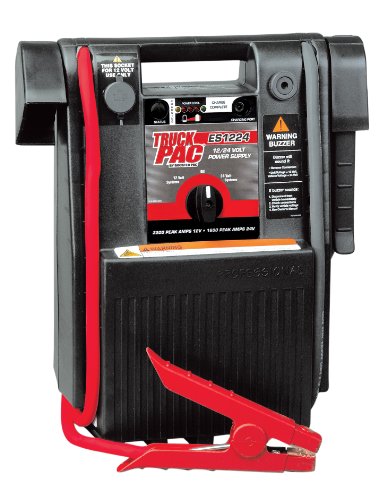
The ES1224 provides 12/24V operation with 3000 peak amps at 12V and 1500 peak amps at 24V, paired with 60-inch #2 gauge cables. This model targets heavier-duty needs and larger vehicles, such as trucks and work vans, where longer reach and robust starting power are essential.
Best for: Professional shops and fleet managers handling larger vehicles and frequent cold starts.
Limitation: It uses longer cables which may be cumbersome in tight spaces and requires careful handling to manage the higher cable length.
YESPER 12V/24V Jump Starter

YESPER’s jump starter delivers 6000 peak amps with auto 12V/24V detection, designed to jump-start all gasoline and diesel engines. It can handle up to about 65 starts per charge and is engineered for cold-weather reliability with pre-heating technology. It is suitable for users who face extreme temperatures and need a robust, portable emergency power source.
Best for: Users in very cold climates or those needing a high-capacity unit that can handle large engines and repeated starts.
Limitation: Manual switching may be required when starting a completely dead car; always verify voltage mode for the engine size before starting.
Primedura 30,000A 1S Startup Jump Starter

This heavy-duty unit claims 30,000A peak and 3,000A/1,500A rated currents across 12V/24V, intended for extreme workloads. It supports diesel engines up to 50L and gasoline engines up to 99L, with a rugged ABS+PC shell designed for harsh conditions and a safe, long-lasting lithium-based system. It is best for industrial applications requiring maximum starting power and robust protection features.
Best for: Industrial fleets, construction equipment operators, and emergency responders needing high-powered, rugged performance.
Limitation: Very high power may be more than what a typical personal vehicle requires, and the unit’s size may reduce portability for casual users.
Buying Guide
Key considerations help you select the right 12V/24V booster starter:
- Vehicle type and engine size: Light cars vs. trucks, diesel vs. gasoline engines.
- Peak vs. running amps: Higher peak power helps with completely dead batteries; sustained amps affect repeated starts.
- Voltage switching: Some models automatically detect 12V/24V; others require manual changes. Choose based on your comfort level and typical vehicle types.
- Cable length and gauge: Longer cables improve reach but add weight; heavier gauge cables offer better current handling.
- Safety features: Look for spark-proof, reverse polarity protection, over-current and over-discharge protections.
- Portability vs. durability: Compact units are easy to store; heavier units are built for frequent use in fleets or workshops.
Frequently Asked Questions
- What is the difference between a 12V and a 24V jump starter?
- Can a 12V jump starter start a diesel engine?
- Should I leave a jump starter plugged in after charging?
- What safety features are important in jump starters?
- How long does a jump starter’s battery typically last?
- Can I jump multiple vehicles with one unit?
12V and 24V refer to the starting voltage the unit delivers. Some engines start more reliably at 12V, while larger engines benefit from 24V or simultaneous dual-voltage capability.
Yes, if the unit provides sufficient peak current and has appropriate safety features. Diesel engines typically require higher amperage than many gasoline engines.
Follow the manufacturer’s guidelines. Many units include advanced BMS and should be safely disconnected after charging to prevent overcharging.
Reverse polarity protection, short-circuit protection, overload protection, spark-proof design, and temperature monitoring are important for safe operation.
Battery longevity depends on usage, charging habits, and environmental conditions. Most units feature several years of standby life with proper care.
Many units are designed for multiple starts per charge, but this depends on battery capacity and the engine size being started. Check the manufacturer’s specified start-per-charge limits.