Answering the need for quick, visible temperature indicators on brake calipers, these products help track peak temperatures on track days or street use. Best for racers and performance enthusiasts who want a simple, at-glance readout of brake temperatures to prevent fade or damage. This guide highlights five top options, explaining who each product is best for, plus practical pros and limitations.
Product Comparison Snapshot
| Product | Best For | Notes |
|---|---|---|
| Motorsport Brake Caliper Temperature Indicator Strips | Track racers needing wide temp ranges | Wide range labels from 380–465°F |
| Wilwood Temperature Measuring Indicator Strips | Budget-conscious enthusiasts | 10-pack basic indicators |
| R&G Brembo High Temp Caliper Decal Set | Showcasing high-temp branding | Vinyl decals, stylish; not a readout |
| R&G 300 High Temp Brake Caliper Decal Set | Black high-temp branding | Two sizes; easy application |
| Phoenix Systems 8006-B Test Strips | Brake fluid and coolant health | Dual-purpose test strips for maintenance |
Motorsport Brake Caliper Temperature Indicator Strips

The Motorsport Thermolabel strips provide discrete temperature readouts across a defined peak range. The set includes 16 labels with stepping points at 380°F, 390°F, 400°F, 410°F, 420°F, 435°F, 450°F, and 465°F. Best for dedicated track days where precise, per-caliper temperature tracking helps manage brake performance. Best for racers and serious track-day enthusiasts who want a clear, track-ready indicator without digital instrumentation. Limitations include the fixed temperature steps; if your target range falls between marks, interpretation may be less precise.
Wilwood Temperature Measuring Indicator Strips

Wilwood’s indicator strips come in a compact 10-pack designed for quick readability. They’re suitable for buyers who want a straightforward, affordable option and don’t require an extensive range of temperature marks. Best for budget-conscious drivers and mechanics who still want a dependable calibration check on or off the track. A limitation is the fewer temperature breakpoints, which may reduce precision for some high-heat situations.
R&G High Temp Brake Caliper Decal Sticker Set (Black) — 4 Decals

These R&G decals are designed to adorn calipers with a high-temperature look and branding. They’re best for users who want a durable, visually striking decal solution that withstands heat while adding a sporty aesthetic. Not a temperature readout, but useful for signaling high-temperature intent visually. Choose this if you want a bold, low-maintenance branding option rather than a measurement tool. Limitation: no temperature data or readout, just a decorative high-heat label.
R&G 300 High Temp Brake Caliper Decal Sticker Set (Black) — 4 Decals

This R&G decal set offers two sizes with a straightforward, single-use installation. Built from high-quality vinyl to endure heat exposure, these decals aid in creating a cohesive, heat-themed appearance across multiple calipers. Best for owners who want consistency in aesthetics and branding for high-temperature components. Limitation: does not provide any measurement data.
Phoenix Systems 8006-B Brake Fluid + Coolant Test Strips
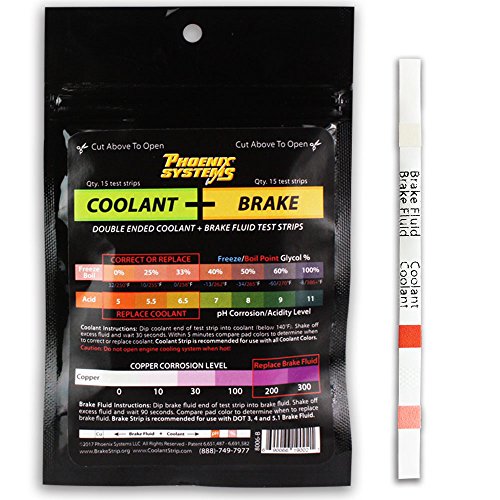
These dual-ended test strips assess both brake fluid quality and coolant readiness. They’re useful for maintenance planning and safety assurance, especially for vehicles used in variable climates or on track days. Best for technicians or DIYers who perform regular fluid checks as part of a broader brake care routine. Caution: not a direct brake caliper temperature indicator, but a complementary gauge for overall system health that can influence braking performance.
Buying Guide
Key considerations when selecting brake caliper temperature indicators or related heat-ready accessories:
- Temperature range and resolution: Choose strips with ranges that cover your operating conditions. Wider ranges help on varied tracks, while finer steps aid precise readings on high-heat sessions.
- Readability: Bold, easy-to-interpret markings reduce ambiguity during pit stops and in photos for documentation.
- Durability under heat: Caliper environments are hot; select vinyl or label materials designed for high-temperature exposure.
- Aesthetics vs. data: Decals provide branding and appearance; temperature strips provide data for performance decisions. Align with your goals.
- Maintenance and application: Some decals are simple peel-and-stick; others require surface prep. Consider your available time and skill level.
- Compatibility: If you already run track decals or heat indicators, ensure color contrast and placement won’t interfere with existing markings or hardware.
Practical Scenarios
- Track day veteran wants clear per-caliper temperatures to manage fade risk. Best choice: Motorsport Thermolabel strips for explicit temp cues.
- Budget racer seeks a straightforward readout with minimal setup. Best choice: Wilwood indicator strips in a 10-pack.
- Show-piece build emphasizes aesthetics as well as function. Best choice: R&G decal sets for a high-temp look without measurement data.
- Maintenance-focused user wants to monitor fluid and cooling health alongside temps. Best choice: Phoenix Systems test strips for comprehensive checks.
Frequently Asked Questions
- What is a brake caliper temperature strip?
- Are temperature strips more accurate than digital sensors?
- Can decals interfere with brake performance?
- Should I use temperature strips on all four calipers?
- Do these indicators require maintenance?
- How do I interpret the readings?
A brake caliper temperature strip is a heat-sensitive label or indicator placed on a caliper to show peak temperatures reached during braking, helping to gauge thermal load and prevent overheating.
Temperature strips provide quick at-a-glance readings without electronics, while digital sensors offer continuous data and finer resolution. Strips are often easier to deploy and read in the paddock.
Decals designed for high-temp use are typically non-invasive and won’t affect braking performance. They mainly serve aesthetics and branding; they do not read temperatures.
Yes, applying strips to all calipers provides a complete view of thermal distribution across wheels, which is especially valuable on high-speed or varied-track layouts.
Most strips are single-use or require minimal maintenance. Some decals may need surface preparation for proper adhesion during installation.
Read the mark that corresponds to the peak temperature the caliper reached. Compare across wheels to identify hotspots or uneven cooling that might need brake balance adjustments.