Answering buyers seeking a reliable car code tester: these OBD2 scanners read and clear engine codes, show live data, and help you assess engine health. They’re best for DIYers, car owners, and hobbyists who want fast, clear diagnostics without a trip to the shop. Below are five well-rounded options, chosen for broad vehicle coverage, ease of use, and practical data display. The quick reference table helps compare core specs at a glance.
| Product | Key Benefit | Best For | Notes |
|---|---|---|---|
| ANCEL AD310 | Fast code reading and clearing with live data | General diagnostics for most 1996+ vehicles | Compact and sturdy with clear display |
| VDIAGTOOL VD10 | Extensive DTC database and code lookup | Home mechanics who want detailed code explanations offline | Good all-rounder for everyday use |
| MOTOPOWER MP69033 | Supports 9 protocols and real-time data | Wide vehicle compatibility | Simple LCD display, battery-friendly |
| Innova 5210 | OBD2 scan plus battery tester | Vehicles with battery health concerns | Versatile tool for fleet or family cars |
| FOXWELL NT301 Plus | 2-in-1: code reader and 12V battery tester | Pre-trip checks and routine maintenance | Larger color display, clear results |
ANCEL AD310 Classic Enhanced OBD II Scanner

The AD310 reads and clears diagnostic trouble codes for emission systems and provides live data, freeze frame, I/M readiness, and vehicle information. It’s best for general-purpose diagnostics on most 1996 or newer OBD2 vehicles. Its compact design and clear display support quick checks in a driveway or garage. It draws power directly from the vehicle rather than requiring a battery or charger, making it convenient for mobile use.
Best for: DIYers and casual users who want a straightforward, reliable code reader with fast results. It’s a solid pick for those who need a compact tool that travels well and offers essential data without extra frills.
Caution: The device relies on the vehicle’s OBDII port; some advanced vehicle-specific codes may require more specialized equipment to diagnose.
VDIAGTOOL VD10 OBD2 Scanner
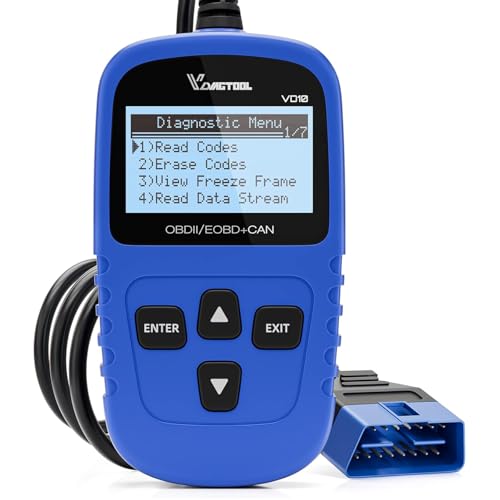
VDIAGTOOL VD10 offers read and clear codes, live data, freeze frame, I/M readiness, and a built-in DTC library with more than 3,000 codes. It retrieves both generic and manufacturer-specific codes, and presents definitions on the TFT screen. The tool’s offline lookup helps users quickly understand problems without internet browsing.
Best for: Home mechanics who want a comprehensive local reference and broad code coverage across many brands. It’s a strong all-purpose option for diagnosing engine faults without cloud dependence.
Caution: While it provides extensive code definitions, some very new or highly specialized codes may require online resources for full resolution.
MOTOPOWER MP69033 OBD2 Scanner

This scanner supports 9 protocols and provides live data, fuel information, and engine parameters. It’s designed to work with most 1996 US-based, 2000 EU-based, and Asian vehicles. The 2.8-inch LCD display is easy to read, and the device powers from the vehicle, avoiding extra batteries or chargers.
Best for: People with a diverse vehicle lineup who want broad compatibility in a simple, plug-and-play unit. It’s especially suitable for quick pre-drive checks and general diagnostics.
Caution: Advanced diagnostics beyond standard DTC reading may require more specialized tools or manufacturer software for deeper analysis.
Innova 5210 OBD2 Scanner & Engine Code Reader

The 5210 combines OBD2 scanning with a battery tester, enabling checks of alternator health and general electrical system status. It provides live data, drive cycle readiness, and the ability to read and erase engine codes with targeted guidance. Compatibility covers a broad range of vehicles from 1996 onward.
Best for: Car owners who want an all-in-one diagnostic and battery health tool, useful for preventative maintenance and routine checks.
Caution: Coverage for ABS codes may vary by vehicle; verify model compatibility for specific make and year before relying on ABS results.
FOXWELL NT301 Plus OBD2 Scanner

The NT301 Plus combines a code reader with a 12V battery tester, offering a larger 2.8-inch color display and a 36% larger color screen than earlier models. It helps with engine codes, battery health, starting and charging system checks, and live data readouts. It’s designed for DIYers and home mechanics who want a single tool for routine diagnostics.
Best for: Users who want a dual-function device to diagnose engine faults and monitor battery health on a single screen, with easy-to-read visuals.
Caution: Battery tests are indicative and may not replace a professional battery analyzer for critical vehicle systems.
Buying Guide: Key Considerations for Your Car Code Tester
Choosing the right OBD2 scanner depends on features, vehicle coverage, and how you plan to use the tool. Consider the following:
- Vehicle compatibility: Confirm the scanner supports your make, model, and year, especially for non-US brands.
- Code reading vs. clearing: Some devices read but do not clear codes without repair work; others clear codes after repairs. Determine your needs.
- Data visibility: Look for large, legible displays and whether live data or freeze-frame information is included. Color screens can help readability in sunlight.
- Glossary and lookup: Built-in DTC definitions save time. An offline database is helpful when internet access is limited.
- Battery testing capabilities: If battery health is a concern, consider models that include a battery/charging system test.
- Ease of use: For beginners, a user-friendly interface and clear guidance are important. Language options can aid comprehension.
- Future-proofing: Some tools offer firmware updates and expanded protocol support to handle newer vehicles.
FAQ
- What does an OBD2 scanner do? It reads diagnostic trouble codes from the vehicle’s onboard computer and can clear codes once issues are addressed.
- Do all cars support OBD2? Most 1996 and newer US, EU, and many Asian vehicles support OBD2 and CAN protocols; check your vehicle’s port and manual.
- Can I use these tools to diagnose battery problems? Some devices include battery health testing features, but specialized battery testers may be more accurate for critical diagnoses.
- Is it necessary to repair the car before clearing codes? Clearing codes is often allowed after fixes; some codes may reappear if the underlying issue isn’t resolved.
- Should I buy a Bluetooth scanner or a handheld device? Bluetooth scanners offer wireless convenience and mobile app access, while handheld devices provide offline reliability and a dedicated screen.
- How accurate are built-in DTC definitions? Built-in definitions are generally helpful, but for complex issues, professional diagnostics or manufacturer software may be required.