Answering the demand for precise, quick paint thickness measurements, these gauges help buyers identify hidden repairs, refinishes, or mismatched panels on used cars. They’re ideal for used-car buyers, detailers, inspectors, and dealership staff who need clear, objective data. The following selections cover popular models that support Fe/NFe substrates, offer automatic detection, and provide easy-to-read results for everyday buyers and professionals alike.
| Product | Best For | Key Benefit | Approx. Range |
|---|---|---|---|
| Paint Thickness Gauge CM-205FN (VVV-Group) | Used car inspections, detailers | Automatic Fe/NFe detection; 0.1 μm resolution | 0–1500 μm |
| Paint Thickness Gauge CM-224 Auto (VVV-Group) | Dealerships, inspectors | Factory calibrated; automatic substrate detection | 0–1500 μm |
| CM-224Pro Automotive Coating Thickness Meter (VVV-Group) | Professional evaluators | Zn auto detection; 0.01 mils resolution | 0–1500 μm |
| YOWEXA Coating Thickness Gauge | Field inspections, mobile appraisers | External probe; data storage with USB export | 0–2000 μm |
| AstroAI Paint Thickness Gauge | Used car buyers | Automatic detection; broad coating compatibility | 0–∞ (varies by substrate) |
Paint Thickness Gauge CM-205FN for Cars – Digital Coating Thickness Meter

The CM-205FN offers high-accuracy coating measurements with 0.1 μm resolution and ±(3%+2 μm) accuracy. It automatically detects Fe (steel/iron) and NFe (aluminum/copper), applying the correct measurement method. Suitable for inspecting doors, hoods, roofs, and other metal panels where precise coating evaluation is needed. Factory-calibrated and ready to use after battery installation, it suits professionals and first-time users alike. Best for quick checks during pre-purchase inspections, dealership visits, and mobile appraisers who need fast readings without setup.
Best for: professionals performing quick pre-purchase checks on mixed-material bodies and detailers who value automatic substrate detection.
Caution: readings can vary if measurements are taken near edges, corners, or on curved surfaces; ensure flat contact for the most stable reading.
Paint Thickness Gauge CM-224 Auto – Digital Coating Thickness Meter

This CM-224 Auto features automatic substrate detection for Fe/NFe/Fe+Zn, enabling measurements on steel, aluminum, and galvanized panels without manual mode switching. It’s designed for automotive inspections, car dealings, and quality checks across car bodies. The large backlit LCD and out-of-the-box factory calibration make it a straightforward choice for professionals and first-time users who need immediate, reliable readings for used-car evaluations.
Best for: buyers and inspectors who work with mixed-material vehicles and want a ready-to-use device with automatic substrate recognition.
Caution: zinc-coated or heavily painted areas might affect readings if not properly contacted; ensure good contact and clean surfaces.
Paint Thickness Gauge – CM-224Pro Automotive Coating Thickness Meter
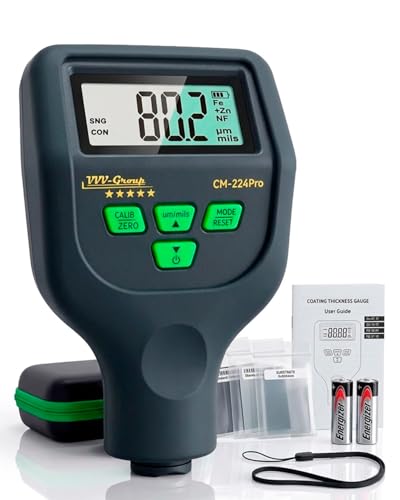
The CM-224Pro delivers professional-grade accuracy with 0.01 mils (0.1 μm) resolution and an automatic Fe/NFe/Zn detection scheme. It supports 0–59.1 mils (0–1500 μm) range and is designed for structured vehicle evaluations across doors, hoods, roofs, and other panels. Fe/NFe/Zn auto-detection helps identify non-original panels during used-car inspections, aiding precise condition reporting for dealerships and independent inspectors.
Best for: professionals who require tight tolerance checks and clear differentiation between original and refinished coatings.
Caution: like all contact gauges, surface cleanliness and proper probe contact affect accuracy; wipe contact areas before measurements.
YOWEXA Coating Thickness Gauge for Fe and NFe Metals
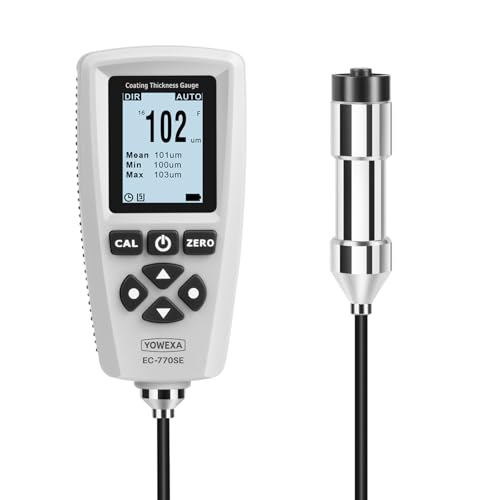
The YOWEXA gauge supports Fe and NFe substrate detection with auto, magnet, and eddy current modes. It includes an external probe for hard-to-reach areas, making it suitable for curved or recessed panels. Data can be stored and exported via USB with up to 2000 readings across four groups, plus mean, min, max, and standard deviation. This model is ideal for field checks, QC documentation, and easy reporting for buyers and appraisers.
Best for: field inspectors and appraisers who need robust data storage and flexible measurement options for varied panel shapes.
Caution: external-probe measurements may take longer in tight spaces; plan measurement order to minimize probe repositioning.
AstroAI Paint Thickness Gauge for Car
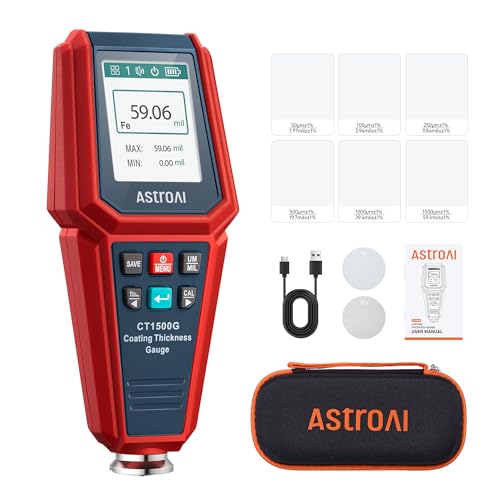
The AstroAI gauge emphasizes automatic detection of ferrous and non-ferrous substrates with broad coating compatibility. It’s a practical choice for used-car buyers who want to assess coating uniformity across panels and spot potential refinishes. The device highlights the need to check thickness variations that can indicate prior repairs, providing clear data to support purchase decisions.
Best for: used-car buyers and general inspectors seeking a balance of automation and broad material compatibility.
Caution: readings can vary when measuring non-flat surfaces; ensure firm contact on flatter areas for consistency.
Buying Guide: Key Considerations For Selecting A Car Paint Thickness Gauge
What substrate detection do you need?
Many modern vehicles use mixed materials. Choose a model with automatic Fe/NFe detection to reduce manual mode switching and improve measurement accuracy across steel and aluminum panels.
What resolution and range matter?
For precise inspection, look for gauges with at least 0.1 μm (0.01 mils) resolution and a range up to 1500 μm (59.1 mils). This setup can reveal subtle thickness differences between factory coats and refinishes.
Is data storage or export important?
Some models offer data storage (up to thousands of readings) and USB export. This is valuable for QC reporting, appraisals, and maintaining records for dealerships or insurance claims.
How easy is it to use in the field?
Factory calibration, backlit displays, and straightforward controls streamline measurements in sunlight, shade, or dim garages. External probes can help reach curved panels but may require additional technique.
What are practical limitations?
Always ensure good contact with clean surfaces. Edges, corners, or heavily curved areas can yield less stable readings. Zinc-coated or galvanized panels sometimes need careful probe placement to avoid misreadings.
FAQ: Quick Answers For Shoppers
- What is a coating thickness gauge used for?
It measures the thickness of paint and coatings on metal panels, helping detect prior repairs, refinishes, or inconsistencies across a vehicle’s body.
- Do these devices work on aluminum and steel?
Yes. Many models include automatic detection for Fe (steel) and NFe (aluminum) substrates, and some support Zn-coated materials as well.
- How precise are the measurements?
Most high-quality gauges offer 0.1 μm (0.01 mil) resolution with ±(3%+2 μm) accuracy, suitable for detailed inspections.
- Can I store readings for reports?
Several models provide internal storage and USB export to support professional documentation and audits.
- Is auto calibration necessary?
Some models arrive factory-calibrated and ready to use, while others may require simple initial setup. Always follow manufacturer instructions for best results.
- What should I avoid when using these gauges?
Avoid measuring over moisture, grease, or dirt. Also, avoid measuring at panel edges or severely curved areas where contact is inconsistent.