Answer: For heavy-duty towing and large hauls, choose high-capacity Class V or Class IV hitches designed to handle substantial gross towing weights. The top options below are best for fleet vehicles, work trucks, and owners who routinely pull heavy trailers. If you specifically need a true Class 8 hitch, consult OEM equipment or specialty suppliers, as these items are typically vehicle-specific. The picks here emphasize strength, compatibility with common 2″ or 2.5″ receivers, and real-world on-vehicle testing where applicable. This guide targets buyers seeking durable, reliable hitches for heavy-duty use on large pickups and work trucks.
Buyer profiles at a glance:
– Fleet operators and pro users who tow daily: CURT 15410 Class V Trailer Hitch sets the standard for maximum strength.
– Heavy-duty owners needing versatile mounting: CURT 14082 Class 4 and CAMMOO adjustable hitches offer broad compatibility and adjustability.
– Truck owners seeking dual-ball versatility: CAMMOO and vullteeon models cover 2″ and 2-5/16″ ball configurations with high GTW.
– Budget-conscious performers who still demand reliability: CURT and ECOTRIC options provide tested, standard 2″ receivers with solid support.
| Product | Best For | Key Benefit |
|---|---|---|
| CURT 15410 Class V Trailer Hitch | Hard-towing pickups and work trucks | Maximum strength with 17,000 lbs GTW |
| CURT 14082 Class 4 Trailer Hitch | Heavy-duty everyday towing | High capacity with flexible accessory options |
| CAMMOO Adjustable Trailer Hitch ML-2080 | Versatile height adjustment | 8″ rise/drop with dual-ball heads |
| vullteeon 8″ Adjustable Trailer Hitch | Extreme leveling for large trailers | 18,500 lbs GTW with dual 2″ and 2-5/16″ balls |
| CURT 13322 Class 3 Trailer Hitch | Moderate-duty to mid-range towing | 2″ receiver with tested, on-vehicle performance |
CURT 15410 Class V Trailer Hitch

Features: This Class V hitch is rated for 17,000 lbs GTW, 2,550 lbs tongue weight, with a 17,000 lbs WD and 2,550 lbs WDTW. It uses a standard 2-inch receiver and supports a heavy-duty ball mount, tow hook, pintle hitch, or winch mount. The finish is designed for rust resistance with a protective coating. Best for heavy-duty trucks and large trailers that require significant pulling power. Limitation: As a Class V hitch, it is larger and heavier; ensure proper installation space and vehicle compatibility.
Best for: Fleet trucks and owner-operators needing maximum towing capacity from a standard 2″ receiver. Why selected: It offers the highest weight ratings among typical consumer options and strong corrosion resistance for demanding environments.
Caution: Verify receiver size compatibility with your vehicle’s frame and ensure the mounting pattern aligns with existing holes and hardware.
CURT 14082 Class 4 Trailer Hitch

Features: Class 4 hitch with 10,000 lbs GTW, 1,000 lbs tongue weight, 12,000 lbs weight distribution capacity, and 1,200 lbs WDTW. Standard 2″ x 2″ receiver; compatible with ball mounts and other heavy-duty towing accessories. Fully tested under real-world conditions per SAE J684 standards. Best for: Heavier everyday towing on mid-range to heavy-duty pickups. Why selected: Offers robust capacity with reliability for frequent towing tasks. Caution: Check compatibility with your specific vehicle model and other towing components.
CAMMOO Adjustable Trailer Hitch ML-2080

Features: 2″ receiver options with 8″ rise/drop, dual 2″ and 2-5/16″ ball heads, and up to 20,000 LBS GTW. It emphasizes universal compatibility for 2″ receivers, with a strong anti-theft pin design. Best for: Towers needing height adjustment to perfectly level trailers when mounting on varied trucks. Why selected: Versatile height adjustment reduces the need for multiple hitch setups. Caution: Confirm receiver inner size (2″ x 2″ only) and outer width to prevent fit issues.
Vullteeon Adjustable Trailer Hitch
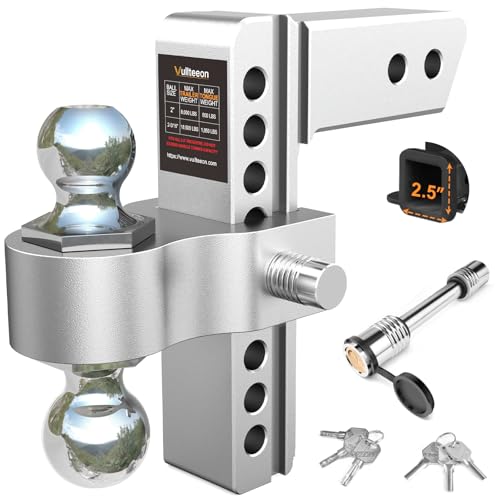
Features: 8″ rise/drop with dual 2″ and 2-5/16″ balls, aluminum body with rust protection, 18,500 LBS GTW. Best for: Users needing precise trailer height matching across a range of trucks and trailers. Why selected: Aluminum construction plus dual-ball design supports durable, versatile towing with reduced corrosion risk. Caution: Ensure measurement accuracy for 2.5″ receivers and confirm weight distribution kit requirements for WD scenarios.
CURT 13322 Class 3 Trailer Hitch

Features: Rated for 6,000 lbs gross trailer weight, 600 lbs tongue weight, 10,000 lbs weight distribution capacity and 1,000 lbs WDTW. This Class 3 hitch uses a 2″ x 2″ receiver, supporting ball mounts, cargo carriers, bike racks, and tow hooks. Fully tested in real-world conditions. Best for: Light-to-mid-range towing on midsize trucks where a sturdy, budget-friendly option is preferred. Why selected: Combines proven strength with broad accessory compatibility at a lower weight class. Caution: Not ideal for very heavy trailers requiring Class V or higher ratings.
Buying Guide: Key Considerations For Heavy-Duty Truck Hitches
- Receiver size compatibility: Most heavy-duty options use 2″ or 2.5″ receivers. Confirm your vehicle’s receiver size before choosing a hitch.
- Towing capacity vs vehicle limits: Match hitch capacity with your vehicle’s gross vehicle weight rating (GVWR) and the trailer’s GTW. Do not exceed the lowest-rated towing component in the system.
- Class designation: Class V hitches offer the highest capacities in consumer products, but Class IV and III options remain common and versatile for many trucks.
- Height adjustability: If you tow trailers of varying heights, consider adjustable rise/drop hitches to keep the trailer level for safer towing and smoother ride quality.
- Finish and corrosion resistance: A rust-resistant finish helps but does not replace maintenance. Look for powder coatings or protective finishes for outdoor use.
- Accessory compatibility: Ensure the hitch supports ball mounts, bike racks, cargo carriers, and other towing accessories you frequently use.
- Installation and fit: Some hitches require drilling, while others are bolt-on. Verify your vehicle’s frame compatibility and installation space.
- Security: If theft is a concern, evaluate anti-theft pins and locking mechanisms provided with the hitch or as accessories.
- Maintenance: Periodic inspection of mounting hardware, rust spots, and electrical connections (if wiring installed) is advised.
Frequently Asked Questions
- What is the difference between Class III, IV, and V hitches?
– Class III typically supports up to about 6,000 lbs GTW, Class IV up to around 10,000 lbs GTW, and Class V up to 17,000+ lbs GTW with higher tongue weight ranges. - Do I need a specific hitch for a 2″ or 2.5″ receiver?
– Yes. Make sure the hitch receiver size matches your trailer and vehicle receiver to ensure a proper fit and safe towing. - Are adjustable hitches worth it for heavy trailers?
– They help maintain a level trailer height across different vehicles and trailers, which improves stability and control while towing. - Is a high-capacity hitch always better?
– Not necessarily. Choose a hitch that meets or exceeds your trailer’s GTW and is compatible with your towing setup. Overcapacity can add unnecessary weight and complexity. - What should I inspect before towing with a new hitch?
– Verify mounting hardware, alignment, electrical connections if present, and ensure the trailer coupler and hitch ball match. - Can I install a Class V hitch on any truck?
– Not always. Some vehicles require OEM or specialized mounting kits. Check manufacturer recommendations and installation guides.