Looking for a durable battery disconnect switch to protect your vehicle’s electrical system? This guide highlights five top picks that balance reliability, ease of use, and installation flexibility. Ideal for cars, trucks, RVs, boats, and ATVs, these switches help prevent parasitic drain and rapid power loss during storage or long idle periods. The best choice depends on your installation style, voltage, and whether you prefer a manual or remote control option. Below is a quick summary of the five products chosen for clarity and quick comparison.
| Product | Best For | Key Benefit | Voltage Range |
|---|---|---|---|
| HINGTAI Car Battery Power Cut-Off Switch | Hands-on installers needing copper conductivity | Adjustable terminals and robust copper design | 12V-24V |
| PTPUO Top Post Battery Disconnect Switch | Long-term storage and flexible mounting | Nylon 66+Brass construction; easy three-way control | 12V-48V |
| UT-LNTELA 2Pcs Battery Disconnect Switch | Two-switch kit for dual-module setups | Pure copper contacts; simple 90° rotation | 12V-24V |
| RVBOATPAT 12V Remote Battery Disconnect | Remote control and theft prevention | Remote kill switch; low standby current | 12V |
| DAIERTEK Remote Battery Disconnect Switch | Smart, adaptable remote control | Universal 12/24V; auto-detection and protection |
HINGTAI Car Battery Power Cut-Off Switch Breaker

The HINGTAI unit uses pure copper for stable transmission and low resistance. It features adjustable terminals that can rotate to fit varied wiring angles, simplifying installation in tight engine compartments. The two-state operation—lift to cut power, lower to restore—helps protect the battery during idle periods and reduces maintenance costs in adverse environments. Best for DIY installers who value a robust copper contact design and flexible mounting, with a clear on/off orientation. Caution: ensure proper torque on mounting hardware to maintain a secure connection in vibration-prone areas.
PTPUO Top Post Battery Disconnect Switch

This top-post disconnect switch emphasizes durability with Nylon 66 housing and solid brass internals. It supports 12V-48V systems and offers easy three-way control including a removable knob for theft prevention. Best for vehicles stored for seasons or RVs needing a secure, high-conductivity disconnect with corrosion resistance. Choose this if you want strong materials and a straightforward three-position control. Limitation: installation might require more space behind the battery post for the knob mechanism.
UT-LNTELA 2Pcs Battery Disconnect Switch

This 2-pack offers high conductivity with pure copper contacts and a simple 90-degree rotate-to-cut design. It’s ideal for dual-circuit setups, or for owners who want redundancy in critical systems. Best for users who prefer a mechanical, easy-to-understand control without electronics. Better for installations where two separate circuits need isolation. Limitation: the two-switch kit requires more mounting space and careful cable routing to avoid interference.
RVBOATPAT 12V 240A Remote Battery Disconnect Switch
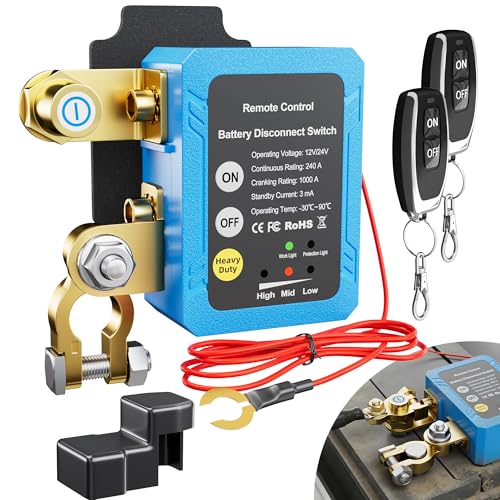
Designed for high-current applications, this 12V remote kill switch handles up to 240A continuously and 1000A instant. It uses a low 3mA standby draw and features a magnetic latching relay for reliable remote control. Best for vehicles that sit unused for extended periods where battery drain is a concern. Choose this for remote operation and battery protection with minimal standby power. Limitation: remote controllers can add a point of failure if the vehicle experiences vibration or moisture exposure in harsh environments.
DAIERTEK Remote Battery Disconnect Switch

The DAIERTEK switch supports both 12V and 24V systems with auto-detection to enter the appropriate mode. It includes protective features that indicate when the supply is outside safe ranges and a manual override for safety. Best for users seeking a smart disconnect with built-in protection and easy wiring that does not require in-depth electronics knowledge. Limitation: remote function protection may disable temporarily during voltage fluctuations, requiring manual override.
Buying Guide
- Voltage compatibility: Ensure the switch supports your system voltage (12V, 24V, or up to 48V). Some models auto-detect or cover wide ranges.
- Control style: Manual rotary switches are simple and reliable; remote switches offer convenience but rely on electronics and wiring integrity.
- Current rating: Match the switch’s continuous and peak current ratings to your battery and loads, especially for high-current vehicles or boats.
- Construction materials: Copper contacts provide better conductivity; nylon or brass housings affect durability and corrosion resistance in harsh environments.
- Installation considerations: Look for negative-ground mounting, easy-to-wire posts, and whether the switch sits on a positive or negative side of the battery.
- Security features: Removable knobs or remote kill switches help prevent tampering in unattended vehicles.
Frequently Asked Questions
- What is a battery cut-off switch used for? It isolates the battery to prevent parasitic drain and protect the electrical system during storage or after a vehicle is parked for an extended time.
- Do I need a professional to install one? Basic installations can be done by skilled DIYers; follow instructions and observe safety precautions when dealing with battery connections.
- Can these switches handle marine use? Many are designed for automotive and marine environments, but verify corrosion resistance and water exposure suitability for your setup.
- Are remote switches safer than manual ones? Remote switches offer convenience and tamper prevention but rely on additional components that could fail; choose based on your risk assessment.
- Will a cut-off switch affect my battery warranty? Some manufacturers may have terms that require proper installation; consult your vehicle’s warranty guidelines before modification.
- How do I choose the right current rating? Match the rating to the highest continuous current draw of the system plus a safety margin for cranking or surge loads.