The top picks below are reliable, budget-friendly engine code readers that read and clear check engine codes, view live data, and assist with MIL resets. They are suited for DIYers, car enthusiasts, and home mechanics who want quick diagnostics without visiting a shop. The list highlights five options that balance ease of use, broad vehicle compatibility, and practical features for engine-focused troubleshooting.
Summary Table of Selected Products
| Product | Best For | Key Benefit |
|---|---|---|
| ANCEL AD310 | Budget-first DIYers | Simple, reliable engine trouble code reader with clear display |
| ANCEL AD410 | All-in-one diagnostic needs | Broad OBDII support and extensive DTC data |
| VDIAGTOOL VD10 | Beginner to intermediate users | Very easy setup, large built-in DTC database |
| FOXWELL NT301 | Live data enthusiasts | Live data graphs and VIN reading in a compact tool |
| ZMOON ZM201 | Clear engine focus | Engine-specific diagnostics with fast code reading |
ANCEL AD310 Classic Enhanced OBD II Scanner

The AD310 is a compact, plug-and-play engine code reader designed for vehicles from 1996 onward that use OBD II. It provides quick reads of emission system trouble codes, allows clearing codes after repairs, and supports live data and freeze-frame views. Best for budget-conscious DIYers who want dependable, straightforward diagnostics without extra frills.
Who it’s best for: Home mechanics and first-time diagnostic users seeking a basic, reliable tool to identify engine codes and reset the MIL after fixes. It’s ideal for routine maintenance checks and quick problem isolation.
Why selected: The AD310’s simplicity, compact design, and clear display facilitate fast code reading and clearing, backed by a long-standing reputation in entry-level OBD readers.
Limitations to note: It lacks more advanced system checks (ABS/SRS) and does not perform deep-level diagnostics beyond engine and emission-related codes.
ANCEL AD410 Enhanced OBD2 Scanner

The AD410 offers broad OBD-II coverage with support for many protocols and multilingual display. It reads and clears fault codes, checks I/M readiness, and provides a robust DTC lookup library. This model is powered directly from the vehicle and does not require a separate battery.
Who it’s best for: Users who want deeper code lookups and reliable diagnostics across a wide range of 1996+ vehicles, including international models. Good for those who value a comprehensive DTC database and ready-to-use functionality out of the box.
Why selected: It stands out for its wide compatibility and rich fault-code library, which helps diagnose emissions-related issues and monitor readiness for smog tests.
Limitations to note: The AD410 is described as an engine code reader with no advanced reset functions for other systems, and it cannot clear fault codes until the underlying issue is resolved.
VDIAGTOOL VD10 OBD2 Scanner
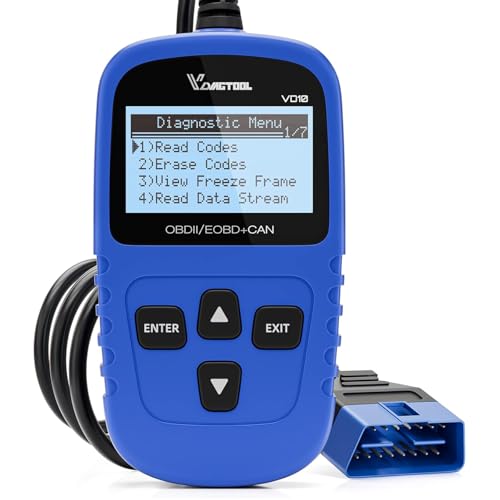
The VD10 is a straightforward OBD-II scanner designed for quick diagnosis. It reads and clears codes, provides DTC definitions from a built-in database, and shows live data and I/M readiness. It is particularly friendly for beginners and hobbyists who want fast results with minimal setup.
Who it’s best for: Newer car owners or DIYers who want a simple, reliable tool to diagnose engine problems and understand fault codes without online lookups.
Why selected: Its user-friendly interface, instant code definitions, and comprehensive live data make it a practical starter tool for engine-focused diagnostics.
Limitations to note: It emphasizes engine diagnostics; some advanced features (ABS/SRS or multi-system diagnostics) are not included.
FOXWELL NT301 OBD2 Scanner

The NT301 is a compact tool geared toward diagnosing check engine lights with additional live data capabilities. It reads DTCs, can turn off the MIL after repairs, and shows live data. It is compatible with most 1996+ gasoline cars, several diesel models, and some Asian and European models, but it does not support ABS or airbag functions.
Who it’s best for: Builders who want a small, portable scanner with clear live data graphs and VIN retrieval for quick verification of vehicle identity.
Why selected: Its balance of essential engine diagnostics, MIL reset, and live data visualization makes it a versatile choice for routine maintenance and basic repairs.
Limitations to note: Not suitable for comprehensive ABS, SRS, or transmission diagnostics; some functions are limited to engine-level testing.
ZMOON ZM201 Professional OBD2 Scanner

The ZM201 focuses on essential engine diagnostics with a large amount of built-in data. It reads and clears engine fault codes, shows I/M readiness, and supports live data and freeze-frame diagnostics. It does not support ABS or transmission diagnostics, making it an engine-centric option.
Who it’s best for: Shoppers who want a straightforward engine-focused code reader with reliable performance and an extensive code database for troubleshooting.
Why selected: With a robust DTC database and practical engine diagnostics features, the ZM201 is a clear engine-oriented tool for quick problem identification and MIL management.
Buying Guide
What should I look for in an engine code reader?
- Vehicle compatibility: Ensure the device supports your vehicle’s year range and OBD protocol (OBD II is standard for most cars since the mid-1990s).
- Core capabilities: Read and clear codes, view live data, check I/M readiness, and retrieve vehicle information. Some models add VIN retrieval or freeze-frame data.
- Specialized functions: Some tools include reset capabilities, EVAP tests, or O2 sensor checks. Check if you need these features before buying.
- User interface: A clear screen, intuitive menus, and multilingual support help accuracy and speed of use.
- Power source: Most readers draw power from the vehicle’s OBD II port; others may require a battery. Confirm power requirements.
Engine-focused vs multi-system scanners
Engine-focused readers are typically simpler and cheaper, covering codes, live data, and MIL resets. Multi-system scanners add ABS, SRS, transmission, and more. Choose engine-focused for straightforward diagnostics, and consider multi-system tools if you need broader vehicle health checks.
How to interpret a code reader result
- Read the DTC and refer to the built-in library for definitions.
- Check I/M readiness and identify pending codes that may indicate issues not yet active.
- Review live data to observe sensor behavior, aiding root-cause analysis.
- Clear codes only after repairs to ensure the MIL remains off and to avoid masking ongoing issues.
Connectivity and data handling
Most devices connect via the OBD II port, with some offering Bluetooth or USB connectivity for PC or app-based readings. If you need to log data or share results, verify how data is stored and exported.
Warranty and support considerations
Look for basic warranty and accessible customer support. A reliable vendor will provide clear guidance on compatibility and troubleshooting steps.
FAQ
- Do these tools require a battery? Most plug directly into the vehicle’s OBD II port and draw power from the car. Some models may include a battery in the tool, but it’s not universal.
- Can these scanners clear all codes? They can clear codes after repairs, but persistent maintenance-related codes may reappear if the underlying issue isn’t fixed.
- Will they work on all cars? They support most 1996+ US, EU, and Asian vehicles with OBD II. Check specific model compatibility with your car’s make and year.
- Do these tools provide live data? Yes, several of these scanners offer live data streams to monitor sensor readings in real time.
- Can I use these on diesel cars? Some models support diesel vehicles; verify protocol compatibility for your specific diesel model.
- Are they suitable for professionals? They’re primarily geared toward DIYers and hobbyists. For advanced professional diagnostics, higher-end tools with broader system coverage may be needed.