Answering the core buyer question: which engine management code readers deliver fast, reliable diagnostics for common check-engine issues? This guide highlights five top options and clarifies who each is best for. Ideal for DIYers, weekend mechanics, and professional technicians, these tools read and clear codes, view live data, and check readiness. The top picks offer broad OBDII coverage, ease of use, and practical data displays to help you pinpoint problems without guesswork.
| Product | Best For | |
|---|---|---|
| ANCEL AD310 Classic Enhanced Universal OBD II Scanner | AD310 | First-time users needing fast code reading and clearing |
| VDIAGTOOL VD10 OBD2 Scanner | VD10 | DIYers seeking built-in DTC definitions and wide compatibility |
| ANCEL AD410 Enhanced OBD2 Scanner | AD410 | Owners of diverse vehicles seeking broad coverage and MIL reset |
| FOXWELL NT301 OBD2 Scanner | NT301 | Professional-like live data and diagnostic capability |
| MOTOPOWER MP69033 OBD2 Scanner | MP69033 | Budget-conscious users needing multi-function read/erase and data |
ANCEL AD310 Classic Enhanced OBD II Scanner

The AD310 is a compact, sturdy tool designed for quick fault code retrieval and clearing. It supports 1996+ OBDII vehicles, reads live data, freeze frame, I/M readiness, and vehicle information. It is powered directly from the vehicle, with no batteries required. Best for new or casual users who need fast results and a reliable, portable scanner that’s easy to carry in a toolbox. A potential limitation is its feature set, which focuses on core OBDII functions without advanced subsystem testing.
VDIAGTOOL VD10 OBD2 Scanner
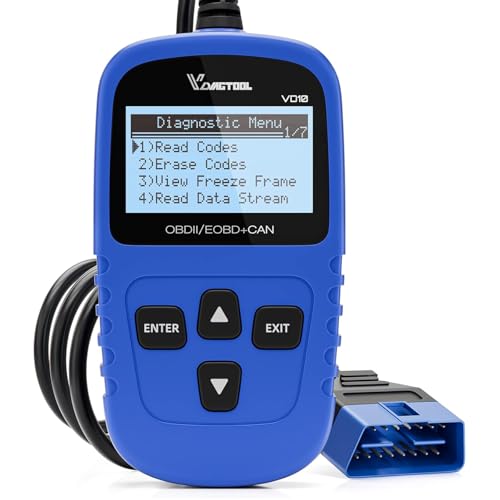
The VD10 is a user-friendly tool designed for DIYers and hobbyists. It reads and clears codes, shows DTC definitions from a built-in database (over 3,000 codes), and provides I/M readiness data and vehicle information. It’s best for people who want clear on-screen explanations without internet lookups and prefer a straightforward interface. Limitation: it emphasizes generic and manufacturer-specific codes rather than extensive subsystem testing.
ANCEL AD410 Enhanced OBD2 Scanner

The AD410 provides broad OBDII diagnostics with multilingual support and compatibility across many 1996+ vehicles. It quickly reads and clears fault codes and includes advanced diagnostics like O2 sensor and EVAP testing. It is best for users who want a robust, fuel-system-focused tool and don’t need ABS/SRS or other non-engine modules. Caution: while it offers strong engine diagnostics, it does not support some advanced vehicle systems.
FOXWELL NT301 OBD2 Scanner

The NT301 targets professionals and serious enthusiasts with live data graphs, VIN retrieval, and MIL control. It supports most 1996+ gasoline cars and several diesel 12V models, though it does not perform full-system scanning (ABS, SRS, or other non-engine functions may be limited). Best for users who want detailed data visualization and robust fault code handling in a compact handheld unit. A potential limitation is that some advanced features require careful navigation to access correctly.
MOTOPOWER MP69033 OBD2 Scanner

The MP69033 offers multi-function read/erase, live data, freeze frame, and I/M readiness with a clear 2.8″ LCD display. It supports 9 protocols and multiple languages, making it a solid choice for budget-conscious buyers who still want a capable OBDII tool. Best for those who want a larger display and basic real-time data without paying for higher-end features. Limitation: advanced system tests beyond engine diagnostics are not included.
Buying Guide: Key Purchase Considerations
- Vehicle compatibility: Ensure the device lists your vehicle’s year range and protocol (OBDII/CAN) support.
- Code reading vs. clearing: Some models emphasize reading only, while others read, clear, and reset MIL lights. Choose per your needs.
- Live data and graphs: If you want real-time trends, prioritize models with live data streaming and graphing capabilities.
- Built-in DTC definitions: A robust internal database reduces the need to search online for code meanings.
- Power source: Most tools draw power from the OBDII port; battery-powered options add flexibility but may require maintenance.
- Language and regional use: Multilingual support is helpful for non-English users; ensure your preferred language is available.
- Ease of use: Look for intuitive menus, clearly labeled buttons, and concise on-device instructions.
- Limitations to expect: Some tools focus on engine codes only; others test additional subsystems. Read the specs to match your goals.
Frequently Asked Questions
- What is an OBDII code reader?
A device that connects to a vehicle’s OBDII port to read diagnostic trouble codes, view live sensor data, and sometimes clear codes or reset the MIL. - Do I need a pricey scanner to diagnose most problems?
No. For basic engine code reading and MIL resets, a mid-range scanner often suffices. More advanced tools provide live data graphs and broader subsystem diagnostics. - Can these tools fix car problems?
They aid diagnosis by identifying fault codes, but they do not repair problems. Repairs require mechanical work or professional service. - Will these scanners work on all makes and models?
Most OBDII scanners cover 1996+ US-based, EU-based, and many Asian vehicles. Always verify specific model compatibility before purchase. - Is live data important for diagnosing engines?
Yes. Live data helps verify sensor behavior over time and can reveal intermittent issues not visible from codes alone. - Do any of these devices require an external battery?
Most draw power from the vehicle’s OBDII port; some models may include a built-in battery option, but it’s not common for engine-focused readers.