Choosing the right Euro 5 engine oil helps protect engines designed for European fuels and climates. This guide highlights five top options and clarifies which drivers each is best for, from daily drivers to performance-focused vehicles. Each product is selected for compatibility with European engines and their requirements for friction control, deposit prevention, and temperature stability.
| Product | Best For | Key Benefit |
|---|---|---|
| Valvoline European Vehicle Full Synthetic 5W-40 | Gasoline and diesel European cars | Strong anti-wear protection and deposits control |
| Mobil 1 European Car Formula 0W-40 | Extreme climates and severe service | Excellent oxidation control and long oil life |
| Valvoline European Vehicle Full Synthetic 5W-30 XL-III | European fleet with emissions systems | Low-SAPS compatibility and wide temp protection |
| Castrol Edge Euro 0W-40 A3/B4 | High-performance European engines | Advanced viscosity control and piston cleanliness |
| Castrol EDGE Euro 5W-40 A3/B4 | European cars under high pressure | Fluid TITANIUM Technology for strength under load |
Valvoline European Vehicle Full Synthetic 5W-40 Motor Oil 5 QT

Best for: European gasoline and diesel engines needing robust wear protection and deposit control. This formulation targets the four main causes of engine breakdown: wear, friction, heat, and deposits, with anti-wear additives that exceed many OEM standards.
Why selected: The advanced protection profile aligns with European engine design expectations and helps safeguard against damaging deposits while maintaining performance in varied conditions.
Caution: For engines that require low-SAPS formulations to protect emission systems, verify compatibility with your vehicle’s specific emissions hardware before use.
Mobil 1 European Car Formula Full Synthetic 0W-40

Best for: European vehicles in severe conditions and climates where oil life and viscosity stability are critical. It emphasizes long service intervals and oxidation resistance.
Why selected: Its ability to maintain viscosity up to extended miles supports engines under demanding operation, with uniform molecular structure helping reduce friction.
Caution: Some European engines may require specific viscosity grades; confirm that 0W-40 is recommended by your owner’s manual for your model and region.
Valvoline European Vehicle Full Synthetic 5W-30 XL-III

Best for: European gasoline and diesel engines that require low-SAPS oil to protect emissions systems while delivering reliable performance across temperatures.
Why selected: The XL-III variant combines advanced protection with compatibility for emissions equipment, supporting long-term engine cleanliness and reliability.
Caution: Not all engines that require 5W-30 may accept XL-III; check your owner’s manual for SAPs and sequence approvals before use.
Castrol Edge Euro 0W-40 A3/B4 Advanced Full Synthetic
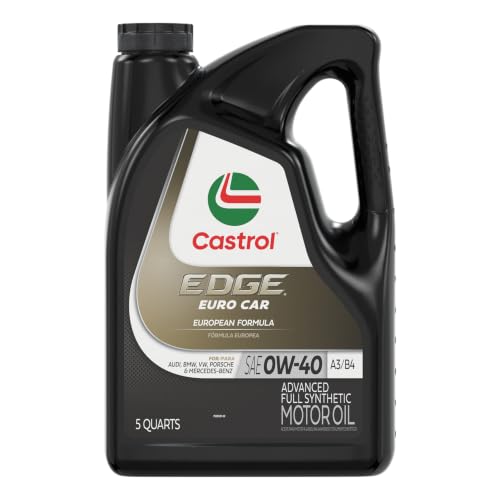
Best for: High-performance European engines that demand strong viscosity control and piston cleanliness under load.
Why selected: Castrol Edge with 0W-40 viscosity supports engine protection across cold starts and under high-temperature operation, with notes highlighting improved viscosity control and cleanliness.
Caution: Some diesel engines or specific OEM sequences may prefer different grades; verify compatibility with your vehicle’s specification sheet before use.
Castrol EDGE Euro 5W-40 A3/B4 Advanced Full Synthetic

Best for: European engines under high pressure and temperature, requiring strong film strength to prevent oil breakdown.
Why selected: Fluid TITANIUM Technology enhances film strength to resist break-down under stress, offering potential performance advantages in demanding driving conditions.
Caution: Higher-performance claims relate to specific European engines; ensure your model’s approvals align with ACEA/OEM requirements before using.
Castrol EDGE Euro 5W-30 K Advanced Full Synthetic

Best for: European engines that require strong wear protection and engine cleanliness, especially with tight tolerances in modern designs.
Why selected: The product emphasizes wear protection and cleanliness with multiple test-backed improvements, aligning with premium European specifications.
Caution: Ensure the exact OEM specification matches your vehicle, as some engines specify particular ACEA sequences or API limits.
Buying Guide: Key Considerations For Euro 5 Engine Oils
- What does your vehicle’s owner manual specify for viscosity (5W-40, 0W-40, 5W-30, etc.) and SAPs? Choose oils that meet those exact requirements to protect emissions systems and engine tolerances.
- Oil type: Full synthetic oils offer better protection at high and low temperatures and longer change intervals, important for European engines with demanding driving cycles.
- ACEA and OEM approvals: Some engines require particular ACEA sequences or OEM licenses. Confirm the oil meets the necessary specifications for your car’s engine family.
- Emission system compatibility: For vehicles with diesel particulate filters or gasoline particulate systems, consider low-SAPS formulations if required.
- Climate and driving: In extreme heat or cold, select oils with proven high/low temperature protection to minimize viscosity changes and maintain lubrication.
- Parity with emissions systems: Oils designed to minimize piston deposits and reduce oil burn-off help maintain engine cleanliness and efficiency.
- Change intervals: Some oils advertise longer intervals; always align with manufacturer recommendations and regional maintenance guidelines.
Frequently Asked Questions
- What is the difference between 0W-40 and 5W-40 oils for European engines?
– Both provide strong protection, but 0W-40 offers better cold-start protection in very cold climates, while 5W-40 commonly supports a wide range of temperatures with robust high-temperature performance. - Is low-SAPS important for European cars?
– Yes, if the vehicle uses an advanced emission-control system. Low-SAPS oils help protect emissions components over time. - Can I mix brands of Euro 5 engine oil?
– Mixing is generally not recommended; stick to the grade and specification that your engine requires, especially for emissions systems. - How do I know which Castrol Edge Euro oil to pick?
– Compare the viscosity grade (0W-40 or 5W-40) and ensure the oil meets your OEM approvals and ACEA sequence requirements. - Do these oils support high-mileage engines?
– Some lines (like high-mileage variants) are designed to address wear and deposits in older engines, but verify compatibility with your vehicle’s maintenance history.