Answering your search for reliable gloss meters for car paint, this guide highlights top portable options that balance accuracy, portability, and ease of use. The listed models are suited for professional auto body shops, detailers, inspectors, and DIY enthusiasts who need quick, repeatable gloss readings across various surfaces. Below is a quick comparison table to help you compare key specs at a glance.
| Product | Best For | Measurement Range | Angles | Notes |
|---|---|---|---|---|
| VEYKOLOR Gloss Meter DG60-Pro | Portable travel use | 0-1200 GU | 60° | Very light; fast single measurement |
| EberSpec Auto Calibration Gloss Meter | Pocketable auto calibration | 1-200 GU | 60° | Auto calibration helps quick setup |
| Landtek GM-6 Glossmeter | Standard lab-like measurements | 0-200 GU | 60° | Good international standard alignment |
| GOYOJO Three Angles Gloss Meter | Multi-angle flexibility | 0-200 GU (60° & 20° available) | 20°, 60°, 85° | USB-C and data export |
| EberSpec Single-Angle 60° | Quiet, reliable 60° readings | 0-200 GU | 60° | Strong data storage; USB-C |
Keep reading for detailed, section-by-section comparisons of each model. Each product section explains who it’s best for, why it was selected, and one practical limitation to consider before you buy.
VEYKOLOR Gloss Meter DG60-Pro: Ultra-Portable 60° Gloss Meter

The VEYKOLOR DG60-Pro is a compact gloss meter designed for on-the-go measurements with a 60° geometry. Its light weight—about 80 grams—and card-sized form factor make it ideal for field work, mobile detailing, or quick shop checks. It offers fast results with single-measure times under one second and has metrological certification backing for accuracy. Best for: mobile detailers, inspectors, or technicians who need quick, repeatable readings without carrying bulky equipment. Caution: small footprint means you may rely on manual handling and alignment for consistent results in dim lighting or dusty environments.
EberSpec Auto Calibration Gloss Meter 60º

The EberSpec Auto Calibration model emphasizes slim design and repeatable measurements. Measuring geometry is fixed at 60°, with a range of 1 to 200 GU. It weighs about 3 ounces, and its slim profile fits easily in a pocket or tool pouch. Best for: technicians who value portability and automatic calibration to reduce setup time. Limitation: the range tops at 200 GU, which may be insufficient for unusually high-gloss finishes in some industrial coatings.
Landtek GM-6 Glossmeter 60º

Landtek’s GM-6 adheres to common industry standards for gloss measurements. It uses a 60° geometry and claims accuracy and good repeatability across surfaces. Best for: professionals seeking a balance between a recognized standard (ASTM/DIN) and reliable repeatability at a mid-range price. Limitation: its 0-200 GU range may be limiting for high-brilliance coatings, and you should ensure your surface is clean for repeatable results.
GOYOJO Three Angles Gloss Meter

The GOYOJO gloss meter offers three angles—20°, 60°, and 85°—providing broader material characterization for diverse finishes like stone, paint, ink, and marble. It supports a high-resolution readout and data export to QC software, which helps manage large data sets. Best for: labs or shops that need multi-angle insight and robust data handling. Caution: higher data load can require more storage and software familiarity, especially for first-time users.
EberSpec Single-Angle 60° Gloss Meter
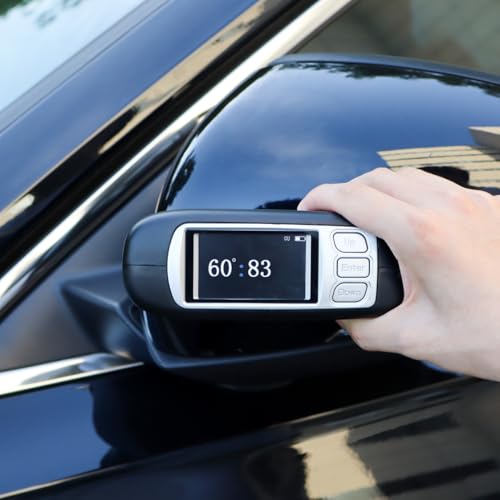
This EberSpec model focuses on a straightforward 60° measurement with a 0-200 GU range and a display accuracy of 1 GU. It supports USB-C charging and provides data storage for up to 5,000 readings. Best for: professionals who want a dedicated 60° gloss meter with dependable endurance and simple operation. Limitation: single-angle focus may not capture surface sheen nuances as effectively as multi-angle devices.
Buying Guide: Key Considerations For Choosing A Gloss Meter
- Measurement Angles: Do you need a single-angle (60°) or multi-angle (20°, 60°, 85°) device to capture different surface finishes?
- Measurement Range: Most auto finishes fall between 0 and 200 GU; some coatings can exceed 200 GU. Choose a range that covers your typical readings.
- Portability vs. Desk Use: For field work, prioritize light weight and pocket-friendly designs. For a shop, consider a robust, fixed setup meter.
- Calibration: Auto-calibration can save time and reduce user error. Manual calibration may be fine for experienced technicians.
- Data Handling: Some models offer on-device storage, USB-C data transfer, or QC software compatibility. Decide how you want to store and export results.
- Material Compatibility: Ensure the device supports common substrates in automotive work (paint, clear coat, plastic, glass, metal, stone).
- Durability and Battery: Durable housings and rechargeable power help in busy environments; check measurement speed and recovery time after each read.
Frequently Asked Questions
- What gloss meter angle should I use for automotive paints?
– A 60° angle is standard for automotive paint gloss testing and provides balanced results across most finishes. - Do I need a multi-angle gloss meter?
– If you work with diverse surfaces (stone, ceramic, metallic paints), a multi-angle meter (20°, 60°, 85°) offers more detailed surface characterization. - Can gloss meters be used for factory-quality assurance?
– Yes, gloss meters with repeatable readings and data export capabilities support QC processes and documentation. - Is auto calibration important?
– Auto calibration reduces setup time and user error, especially in high-volume environments. - What should I look for in data storage?
– Look for devices with on-device storage (for offline use) and options to export to QC software or a PC for reporting. - How do I maintain accuracy over time?
– Regular calibration checks with reference standards and keeping the device clean and properly stored helps maintain accuracy.