Answering the search for a reliable boost leak tester, these products help diagnose boost leaks in turbocharged engines, including Duramax LML setups. Best for automotive hobbyists and DIYers who want to verify charge-pipe integrity after repairs or upgrades. The top picks are suited for diagnosing P0299 and related boost-related codes, improving MPG, power, and engine health. The summary table below highlights core options to consider.
| Product | Best For | Key Benefit | Notes |
|---|---|---|---|
| Duramax 6.6L Premium Turbo Boost Leak Tester | Duramax LML and related 6.6L diesels | 60 PSI boost gauge, billet end cap | Includes 150 PSI regulator, 5 ft hose |
| Duramax-BoostLeakTesters (60 PSI Kit) | Duramax owners focused on leak diagnosis | Comprehensive kit with 60 PSI testing | Shows P0299 and boost issues clearly |
| Orion Motor Tech Turbo System Leakage Tester Kit | Broad car/light truck testing | 4 pairs of adapters for multiple sizes | Includes gauge, regulators, and gloves |
| Yuesstloo 19PCS Turbo System Leakage Tester Kit | Extensive sizing coverage | 16 stepped adapters, 0-87 psi gauge | Smoke adaptor option for leaks |
| Orion Motor Tech Turbo Boost Leak Tester Set | Versatile testing for various vehicles | 6 pairs of adapters for secure fits | Smoke adapter and comprehensive accessories |
Duramax 6.6L Premium Turbo Boost Leak Tester

This tester provides a 60 PSI boost gauge and a billet 6061-T6 end cap, designed to diagnose boost leaks along the entire charge-path from the turbo to intercooler. Best for Duramax LML owners who want a sturdy, high-precision tool for accurate leak detection. A key advantage is testing without removing end components, aiding quick identification of leaks in hot and cold pipes, CAC, Y-bridge, and related clamps.
Best for: Duramax LML enthusiasts who want a robust, clamp-ready tester with a reliable gauge. Choose this if you value billet construction and a complete pressure-regulated setup for safe testing.
Caution: The kit relies on an external air source; verify your compressor capacity to reach 60 PSI safely.
Duramax-BoostLeakTesters (60 PSI Kit)

This 60 PSI kit emphasizes diagnosing boost leaks that trigger codes like P0299 and reveals boost shortfalls across the entire charge path. Its 5 ft hose and ball valve help operators control pressure without bending over the engine bay. It is well-suited for Duramax owners who want a dedicated, all-in-one solution to identify leaks from the turbo discharge through to the exhaust and EGR paths.
Best for: Duramax owners troubleshooting persistent underboost symptoms and wanting clear, actionable leak localization. Better for users who prioritize ease of use and comprehensive leak coverage.
Caution: The kit’s performance depends on a compatible end-cap and hoses; ensure your connections fit your specific model year and pipe sizes.
Orion Motor Tech Turbo System Leakage Tester Kit

This kit provides four adapter pairs and a complete gauge assembly to troubleshoot leaks across turbo, cooling, and emissions systems. Best for users who need broad size coverage and a thorough testing toolkit beyond just the turbo discharge line. The included gloves and DIN adapter add practical usability for workshop setups.
Best for: DIYers and mechanics testing a variety of vehicles, not limited to Duramax. Choose this if you need flexible sizing and a comprehensive accessories bundle.
Caution: Make sure to select the correct adapters for your hose sizes to avoid leakage during testing.
Yuesstloo 19PCS Turbo System Leakage Tester Kit

This 19-piece kit features 16 stepped adapters covering a wide range of hose sizes, a 0-87 psi gauge, and a regulator. It targets turbo, intercooler, cooling pipes, and radiator lines for efficient leak localization. Best for users who work on multiple vehicle types and need precise pressure measurement alongside a broad adapter selection.
Best for: Technicians or DIYers who test a variety of turbo systems and want very granular adapter compatibility. Consider this if you regularly swap hoses or work on different manufacturers.
Caution: The large adapter set can be overwhelming; ensure you have a dedicated workspace to organize fittings and prevent mix-ups during testing.
Orion Motor Tech Turbo Boost Leak Tester Set
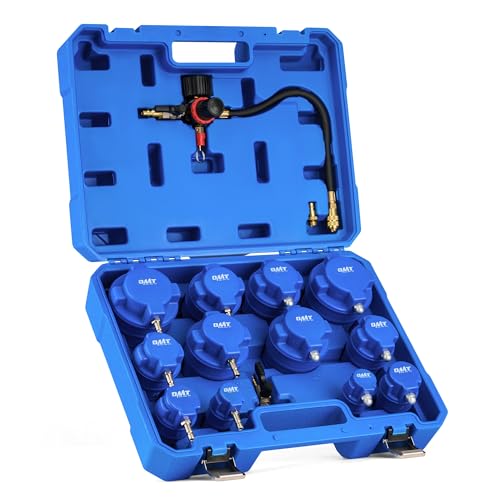
This set focuses on a versatile range of adapters (6 pairs) and includes a smoke adapter for enhanced leak visibility, plus a 0-70 psi gauge. It is well-suited for diverse vehicles and emphasizes ease of use and thorough testing coverage. Best for those who want a balance of adapter variety and functional accessories.
Best for: Car enthusiasts who work with different turbo configurations and need a flexible, smoke-assisted leak detection option. Avoid if you only need a narrow, single-application tester.
Buying Guide
- What size range do you need? Check adapter sets for compatibility with your turbo piping and intercooler connections. Wider ranges reduce the need for extra adapters.
- What pressure rating is appropriate? Most testers operate around 30–60 PSI. Higher-rated devices can better locate leaks but require careful handling.
- Do you want a gauge with a regulator? A built-in regulator and a clear gauge help maintain steady test pressure and accurate readings.
- Is a smoke adapter important? For pinpointing leaks, a smoke adapter reveals small leaks that might be invisible with air alone.
- Are you testing multiple vehicles or a single model? Kits with more adapters and accessories offer more versatility for mixed fleets.
- Material quality and construction: Billet aluminum end caps and rugged fittings improve durability, especially in workshop environments.
FAQ
- What is a boost leak tester used for? It checks for leaks in the turbocharger and charge-pipe system to improve engine performance and diagnose codes like P0299.
- Why use a regulator with the tester? A regulator helps control testing pressure for consistent and safe leak detection.
- Can I test without removing components? Many testers allow testing at the turbo discharge hose with minimal disassembly.
- Which kit is best for Duramax LML? A Duramax-focused kit with 60 PSI testing and a billet end cap is well-suited for LML engines.
- Do testers require an air compressor? Yes, a standard shop air compressor is typically needed to pressurize the system during testing.
- How do I interpret the results? Look for steady boost pressure, no audible leaks, and consistent readings across the entire charge path.