Answering the need for precise, low-pressure tire readings, these gauges help drivers, riders, and fleet owners maintain safe tire pressure without guesswork. The top picks suit ATV/UTV users, golf cart drivers, road-going vehicles, and workshop pros who regularly check low-pressure tires. Each option below is chosen for clear readings, durability, and practical features that aid quick checks.
Product Snapshot
- ETENWOLF Tire Pressure Gauge for Cars 0-75 PSI — Best for night checks and rugged use
- JACO Elite Low Pressure Tire Gauge — Best for rugged hands and built-in bleed valve
- ATsafepro Low Pressure Tire Gauge 1-20 PSI (2-pack) — Best value in a compact pair
- ETENWOLF T300 Digital Tire Pressure Gauge 3-200 PSI — Best digital option for wide range
- WYNNsky Low Pressure Pencil Tire Gauge 1-20 PSI — Best lightweight, portable choice
ETENWOLF Tire Pressure Gauge for Cars 0-75 PSI

Best for: drivers who need a robust, non-digital gauge with strong night visibility. This gauge is calibrated to ANSI B40.1 Grade A with plus-minus 1% accuracy. The large glow dial aids nighttime checks, making it ideal for late-evening roadside tire maintenance.
Why selected: Its manual calibration emphasizes precision across a wide 0-75 PSI range, covering cars, motorcycles, and light trucks. The glow dial reduces error in dim environments, and the device is built for durable, everyday use.
Limitations: It does not include a bleed/deflate feature; overinflation must be corrected with separate tools if needed.
JACO Elite Low Pressure Tire Gauge — 15 PSI
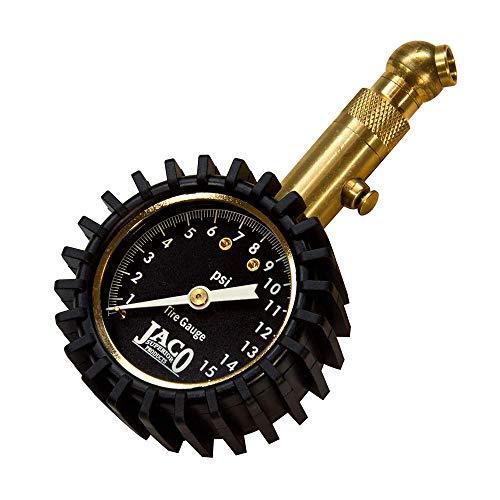
Best for: off-road and ATV enthusiasts who need precise readings at low pressures with a rugged build. This model is designed to ANSI standards (±1.5%) and includes a built-in air bleeder valve for quick deflation and a 360-degree swivel chuck for hard-to-reach stems.
Why selected: Its durable brass core with a shock-resistant guard and the integrated deflator make fine-tuning tire pressure straightforward, especially in workshop or trail environments.
Limitations: It operates within a 0-15 PSI range, so it’s less suitable for higher tire pressures without swapping gauges.
ATsafepro Low Pressure Tire Gauge 1-20 PSI (2-Pack)

Best for: budget-conscious buyers who need two compact, battery-free gauges for spares in multiple vehicles or storage locations. The 1-20 PSI range makes it ideal for inflating RO tanks, golf carts, ATVs, UTVs, and lawn equipment.
Why selected: All-metal construction ensures long-term durability, and the built-in deflator allows quick pressure adjustments without tools. The pencil design and pocket clip support easy carrying.
Limitations: It has a 2-pack requirement; single gauges are not offered in this option, which may affect storage simplicity for some buyers.
ETENWOLF T300 Digital Tire Pressure Gauge 3-200 PSI

Best for: tech-savvy users who need a wide measurement range and digital readings with temperature compensation in extreme weather. This model uses an AI-assisted chip to maintain accuracy from very low to very high pressures.
Why selected: The 3-200 PSI range covers most vehicles, and the ANSI B40.7 Grade 2A (~1 PSI) standard aligns with industry accuracy expectations. The digital display is easy to read in sunlight or low-light scenarios, and its temperature compensation helps keep results stable across climates.
Limitations: Requires replaceable AAA batteries; performance can decline if batteries wear out without replacement.
WYNNsky Low Pressure Pencil Tire Gauge 1-20 PSI

Best for: users who need a lightweight, portable low-pressure gauge for golf carts, ATVs, and air springs. The 1-20 PSI range provides precise readings where higher-PSI gauges are not sufficient.
Why selected: Chrome-plated zinc head with an aluminum body gives durability without bulk. The pencil design makes it easy to carry in a pocket or glove box for quick checks on the go.
Limitations: The slim pencil style may be less comfortable for users who prefer larger handles during frequent use.
Buying Guide
- Range vs. application: Choose 0-15 PSI or 1-20 PSI for low-pressure needs (ATV, golf cart, lawn equipment). For cars or trucks, consider gauges with broader ranges (0-75 or 3-200 PSI) to cover various tires.
- Display type: Analog gauges offer quick readings at a glance, especially in daylight. Digital gauges provide precise increments and features like backlight or unit switching but require battery management.
- Accuracy and calibration: Look for ANSI/B40.x or similar standards and stated error margins (±1% to ±1.5%). Manual calibration can ensure consistent results over time.
- Durability and build: Metal bodies with protective guards resist drops. A built-in deflator is useful for correcting overinflation without tools.
- User experience: Swivel chucks, long stems, and comfortable grips reduce valve-stem leakage and make readings easier in tight spaces.
Frequently Asked Questions
- What is a low-pressure tire gauge best used for? Low-pressure gauges excel at checking tires with pressures under 20 PSI, such as ATVs, UTVs, golf carts, and certain off-road or specialty tires.
- Are digital gauges worth it for low-pressure tires? Yes, digital gauges provide easy-to-read numbers and can offer features like backlighting and unit switching, though batteries are a consideration.
- Can I rely on a pencil gauge for accuracy? Pencil gauges are compact and portable, but ensure you select a model with a reliable mechanism and proper calibration for consistent results.
- Do I need a bleed valve? A bleed/deflator valve helps adjust overinflated tires quickly, which is especially useful for precise tire management during maintenance.
- Which gauge is best for night use? Gauges with a glow dial or backlit display are ideal for reading tire pressure in darkness or low-light conditions.
- How often should I check tire pressure? Check at least monthly and before long trips; inspect whenever tires look visibly underinflated or during seasonal changes.