Answering the common question for DIYers: an oxygen sensor offset socket helps remove and install O2 sensors without stressing wiring harnesses. These tools are ideal for engines with tight clearance or awkward angles. The top options below are best for different priorities—speed, durability, or protecting wires. Read on to find which one fits your vehicle and skill level.
| Product | Drive | Key Benefit | Best For |
|---|---|---|---|
| YOGEIER Offset Oxygen Sensor Socket | 3/8″ | Wire-gate design, compact offset | Hard-to-reach locations |
| Lemxily Offset O2 Sensor Socket | 3/8″ | Cr-Mo steel, wide gate | Durability with wire protection |
| DURATECH O2 Sensor Socket (3/8″ Drive) | 3/8″ | 6-point oval socket, wire gate | Secure grip and wire safety |
| OEMTOOLS 25249 Oxygen Sensor Crowfoot | 2″ drive | Cutaway slot protects wires | Wide vehicle compatibility |
| GIroiyai Oxygen Sensor Wrench & Thread Repair Kit | 3/8″ | Offset low-profile with thread chasers | Thread repair and sensor removal |
YOGEIER Offset Oxygen Sensor Socket

The YOGEIER socket is a 3/8″ drive, 7/8″ (22mm) offset tool designed to reach sensors with the harness still attached. Its wire-gate design helps prevent wire damage during removal and installation. Constructed from chrome molybdenum steel, it aims to deliver torque without deformation. This tool is best for home mechanics tackling vehicles with tight sensor placements. A potential limitation is that some models may require an additional long-reach socket for extremely recessed sensors.
Lemxily Offset O2 Sensor Socket

The Lemxily tool is built for universal O2 sensor removal, using Cr-Mo steel for durability. Its offset design and wire guard help protect sensor cables during disassembly. The socket is compatible with most vehicles, making it a strong general choice for garages that service a wide range of cars. A caveat is that users should verify clearance on particularly tight exhaust manifolds where any extra length could hinder access.
DURATECH 5PCS O2 Sensor Socket Set
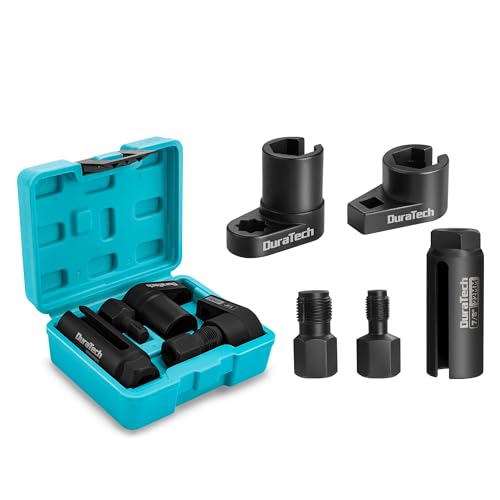
This DURATECH set covers multiple needs: 3/8″ and 1/2″ drive offsets (including long and low-profile crowfoot options) plus thread chasers. Made from alloy steel with surface treatment, the set emphasizes durability and thread protection. The wide wire gates help minimize harness interference. Choose this if you work across many vehicles and need a complete kit with thread repair options. A limitation is that the full set may be more than what a casual user needs.
DURATECH O2 Sensor Socket 3/8″ Drive

This single-purpose socket from DURATECH is a 22mm (7/8″) offset tool designed for standard O2 sensors. It features a wire gate to protect wiring while removing a sensor with the harness connected. The chrome molybdenum construction ensures toughness for repeated use. Best for frequent, focused sensor work on a typical automotive O2 installation. A potential limitation is that it may not be the optimum choice for vehicles with highly tucked sensors.
OEMTOOLS 25249 Oxygen Sensor Crowfoot

OEMTOOLS offers a 22mm crowfoot design with a 2-inch drive, a wide reach for various vehicle layouts. The cutaway slot protects wires from being pinched or damaged during sensor removal. This option suits shop settings or DIYers dealing with multiple vehicles. A limitation is that the larger drive size may require compatible adapters for some ratchets or breaker bars, depending on the work space available.
GIroiyai 5PCS Oxygen Sensor Wrench Kit

The GIroiyai kit includes an offset low-profile O2 sensor socket set with thread chasers. Built from Chrome Vanadium steel, it emphasizes durability and a precise fit with 6-point sockets for reliable torque transfer. It is best for users who anticipate thread damage issues and want built-in tools to repair them. A potential drawback is that the kit may include more pieces than necessary for simple jobs.
Buying Guide
What matters most when choosing an oxygen sensor offset socket?
- Drive size compatibility: Most vehicles use 3/8″ drive; some options include 1/2″ or 2″ drives. Match your ratchets and breaker bars.
- Offset and profile: A low-profile, offset design improves access in tight spaces and underbody headers.
- Wire protection: Look for a wire gate or cutaway slot to prevent harness damage during removal and installation.
- Material and durability: Cr-Mo steel or Chrome Vanadium with protective finishes extend tool life under heat and torque.
- Additional capabilities: Thread chasers or crowfoot options are helpful for repairs beyond simple sensor removal.
- Kit scope: Decide between a single socket and a multi-piece set based on the range of vehicles you service.
How to choose by vehicle type
For modern cars with compact engine bays, prioritize high-access, low-profile offset sockets. For older or heavy-duty vehicles, durability and wider range (thread repair included) can be more valuable. If you frequently encounter sensors with the wires close to exhaust components, a wire gate and proper gate width are essential.
Usage tips
- Always disconnect the vehicle battery if you anticipate sensor removal near wiring to minimize error codes.
- Use penetrating oil with care and avoid overtightening to prevent sensor body damage.
- Inspect harness connections before reinstalling to avoid post-work electrical issues.
FAQ
- What is an oxygen sensor offset socket?
– It is a special tool designed to remove and install oxygen sensors while keeping the wiring harness intact, reducing wire damage. - Why choose a wire gate design?
– A wire gate protects cables from snagging or pinching during removal. - Are these sockets universal for all O2 sensors?
– Most are designed for 7/8″ (22mm) sensors, but always verify sensor size for your vehicle. - Do I need a complete set or a single socket?
– A complete set is useful for shops or multi-vehicle upkeep; a single socket suffices for routine, one-vehicle maintenance. - Can thread chasers be beneficial for O2 sensors?
– Yes, they help repair stripped threads if you encounter damaged sensor mounting threads. - Will these tools fit my ratchet?
– Most are compatible with standard 3/8″ drives, with some options for 1/2″ or 2″ drives; confirm your tool compatibility.