The right pro-grade car battery charger is essential for maintaining battery health, powering ECU reprograms, and keeping engines ready for cold starts. This guide profiles five high-performance options ideal for professional use, fleet maintenance, or serious DIY projects. Each choice suits different scenarios—from field service and workshop use to long-term storage prep. Use the quick reference table to compare core specs at a glance.
| Product | Best For | Key Benefit | Limitations |
|---|---|---|---|
| Clore Automotive PL2320 | Maintenance and light charging | Fully automatic 6V/12V with multiple amp settings | Limited high-current capability |
| Schumacher DSR Pro INC100 | Professional ECU work and service mode | High-current flash/boost modes and service voltage | Bulkier unit |
| TowerTop 25A Max Pro | Balanced home shop and field use | Smart auto charging with desulfation and repairs | Newer brand—availability varies |
| NOCO GENIUS1 | Compact, precise charging for diverse batteries | Thermal compensation and lithium support | Lower max current |
| Porsche Charge-o-mat Pro | Storage and long-term maintenance | Maintains battery via 12V cigarette lighter access | Specialized use case |
Clore Automotive PL2320 20-Amp Fully Automatic Smart Charger

Best for professional maintenance tasks and routine battery upkeep on 6V and 12V systems. The PL2320 offers 2/10/20 amp charge rates and fully automatic operation, simplifying daily work in a workshop or mobile service scenario. Temperature compensation helps protect sensitive systems in varying climates.
Who it’s best for: technicians, shop operators, and fleet managers who need a reliable, automatic charger that flexes between standard maintenance and faster top-ups. Why selected: its versatile amp options and automatic control suit ongoing battery care without constant supervision.
Limitations: lacks ultra-high-current modes for extreme reconditioning; not intended for large, high-demand charging applications. Use for standard automotive and light commercial batteries.
Schumacher Electric DSR Pro INC100
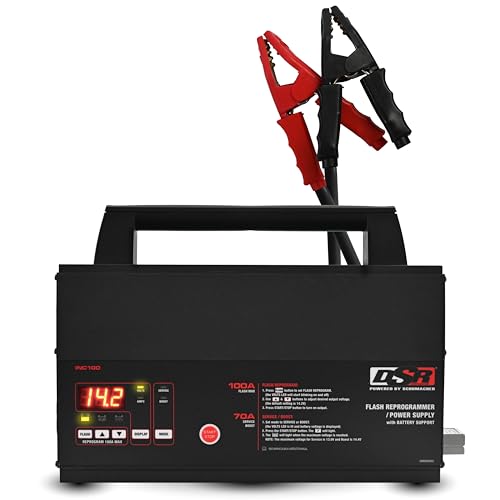
The INC100 is designed for professional-grade work, offering immediate charging power with a 70A–100A flash reprogram mode and a 13.5V service mode up to 14.4V boost. This makes it suitable for 12V automotive and marine batteries where ECU reprogramming or rapid charging is required.
Who it’s best for: technicians performing ECU reprogramming or high-demand battery servicing. Why selected: high-current capability and dedicated service/boost modes help complete advanced procedures efficiently.
Limitations: bulkier footprint and heavier than portable models, which may affect mobile use. Best used in a fixed work area or service van with power readily available.
TowerTop 25A Max Pro Battery Charger

Expertly balanced for both shop and field use, this charger provides 4 settings (3A/15A/25A/AUTO) with an impressive 25A max current. It uses advanced switching power supply technology and a self-developed MCU to boost efficiency and enable desulfation and repair cycles.
Who it’s best for: professionals needing faster charging times without sacrificing efficiency or safety. Why selected: high current capability, smart auto-detection, and robust protection features suit demanding environments.
Limitations: some users may prefer a lighter, more portable unit for occasional use. ETL certification supports safe operation in varied settings.
TowerTop 25A Pro+ Battery Charger
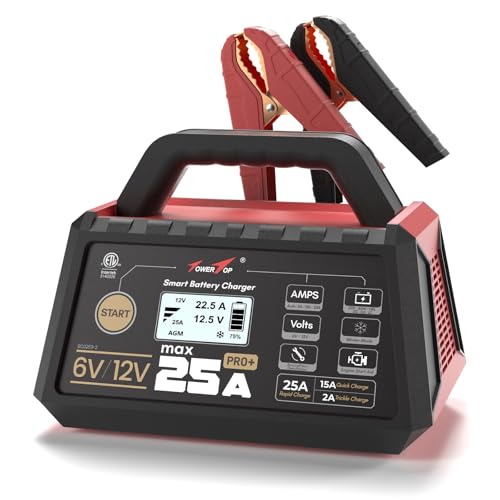
The Pro+ variant expands on the Max Pro with dual-voltage support (6V/12V) and adds more comprehensive desulfation and repair options. It maintains fast charging (up to 25A) and automatic operation, making it suitable for fleets and well-equipped workshops.
Who it’s best for: workshop environments and mobile technicians requiring versatile, full-featured maintenance charging. Why selected: aggressive charging speed combined with advanced battery repair features enhances battery life and readiness.
Limitations: similar to the Max Pro, premium features may be more than needed for casual users. Consider if you regularly handle aging or deep-cycle batteries.
NOCO GENIUS1: 1A 6V/12V Smart Charger

The GENIUS1 is a compact, all-in-one charging solution for 6V and 12V lead-acid and lithium batteries. It includes thermal compensation, an automatic maintenance mode, trickle charging, and a desulfator function. It’s ideal for tight spaces and smaller fleets.
Who it’s best for: mobile technicians and DIY users needing a precise, temperature-aware charger with lithium support. Why selected: small footprint, temperature compensation, and versatile battery compatibility make it a strong all-rounder.
Limitations: the 1A output is low for large batteries or rapid recharging; best for maintenance and small-to-mid sized batteries.
Porsche Charge-o-mat Pro Battery Maintainer

The Porsche Charge-o-mat Pro focuses on battery maintenance for long storage periods. It works with cars that support charging via cigarette lighter or 12V outlets and is positioned for keeping high-value vehicles ready for a long idle.
Who it’s best for: owners who store a vehicle for extended times and want a simple, dedicated maintenance solution. Why selected: ease of use via standard 12V outlets and maintenance-focused operations.
Limitations: not designed for high-current recharging or heavy ECU work; best used as a storage-maintenance tool rather than a primary charging device.
Buying Guide: Pro-Grade Battery Chargers For Professionals
- Current output and charging modes: Choose chargers with adjustable amp settings and dedicated boost or service modes if you perform ECU reprogramming or high-current tasks.
- Battery compatibility: Ensure the charger supports your typical battery chemistries (lead-acid variants, AGM, and lithium where needed). For mixed fleets, a model with lithium support adds flexibility.
- Automation and protections: Automatic charging with reverse polarity, short-circuit, and overcharge protection reduces risk in busy workshops and mobile deployments.
- Desulfation and repair features: If battery life is a concern, consider units offering desulfation or repair modes to extend old or idle batteries.
- Portability vs. power: Balance the need for a compact unit for tight spaces against the demand for higher current in professional use.
- Temperature compensation: Thermal sensing helps prevent overcharging in hot climates and undercharging in cold environments.
- Durability and certifications: Look for ETL or similar safety certifications for reliable performance in various work environments.
- Future-proofing: A charger with multi-volt support and a broad battery range reduces the need for multiple devices as battery technologies evolve.
Frequently Asked Questions
- What is the difference between a battery charger and a maintainer?
A charger actively supplies charge to bring a discharged battery to full, while a maintainer keeps a fully charged battery at a safe, maintained voltage to prevent deterioration. - Can these chargers repair dead batteries?
Some models offer desulfation or repair modes, but effectiveness varies. They are not guaranteed to restore completely dead batteries. - Is lithium support important for automotive use?
Yes, if you own or service vehicles with lithium batteries. Look for units specifically rated for LiFePO4 or lithium chemistries. - Do pro-grade chargers require professional installation?
Most do not, but high-current or service-mode features are best used by trained technicians to ensure proper use and safety. - Which charger is best for long-term storage?
A dedicated maintenance charger with low trickle current and temperature compensation is ideal for extended storage scenarios.