Choosing the right kayak roof rack involves balancing load capacity, mounting compatibility, and protection for your watercraft. This guide highlights five top options that fit a range of vehicles and budgets, with emphasis on durability, ease of use, and secure transport for kayaking trips.
Summary Table Of Chosen Products
| Brand | Model | Load Capacity | Crossbar Fit |
|---|---|---|---|
| PIRIPARA | Kayak Roof Rack 2 Pairs J-Bar Carrier Holder | Up to 150 lbs | 2 Pairs (4 pieces) for 2 kayaks |
| FORWODE | Premium Kayak Roof Rack, 2 Pair J-Bar | Up to 160 lbs | Foldable, adjustable; supports two kayaks |
| Abahub | Soft Roof Rack Pads With Accessories | Not specified; designed for versatile cargo | Universal fit with pads and securing kit |
| VEVOR | Kayak Roof Rack 1 Pair J-Bar | Up to 150 lbs | Foldable, quick installation |
| Yakima | JayLow J-Cradle Rooftop Mount | 1 kayak up to 80 lbs; 2 kayaks up to 110 lbs total | Versatile with adjustable upright options |
Note: The products listed focus on compatibility with common crossbars and a range of kayaks, from single to tandem setups, while emphasizing load safety and ease of use for American adventurers.
PIRIPARA Kayak Roof Rack: Durable 4-Piece J-Bar Carrier
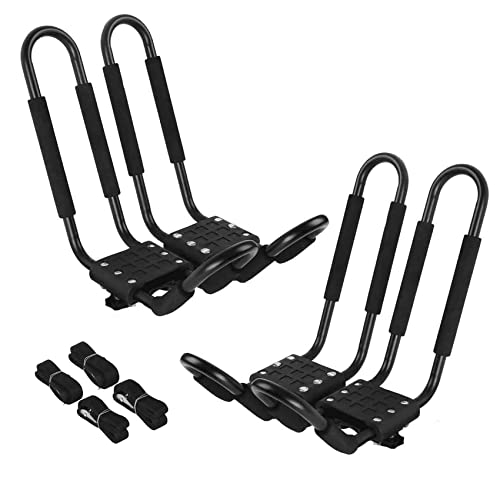
The PIRIPARA system includes 2 pairs (4 pieces) of J-Bar carriers, designed to hold two kayaks securely with a wide-mouth loading approach. Built from sturdy alloy steel, it supports up to 150 lbs total, promoting reliable transport for multiple watercraft. The heavy-duty steel framing features adjustable padding to protect kayaks during transit, while rust-resistant coatings extend product life. This configuration is suitable for SUVs, cars, and trucks, providing a robust solution for weekend paddling and longer expeditions.
FORWODE Premium Kayak Roof Rack: Foldable 2-Kayka Carrier

The FORWODE rack uses a thick-walled carbon steel frame (1.2mm wall, 25mm diameter) to deliver a strong yet lightweight crossbar option. It can support two kayaks up to 160 lbs and features a folding mechanism that rotates from 0 to 180 degrees for easy access and storage. The package includes ratchet belts, straps, and paddle-positioning provisions, reducing the need for extra accessories and ensuring versatility for different kayak shapes and sizes. The rails resist rust and corrosion, making it a solid long-term choice for frequent travelers.
Abahub Soft Roof Rack Pads With Complete Cargo Kit

Abahub combines universal soft pads with a comprehensive securing kit, including two 13 ft tie-down straps, four 16 ft straps, and two T-loop anchors. The 1680D fabric with reinforced PVC coating provides a protective surface that minimizes scratches and reduces noise, making it well-suited for beach and lake trips with kayaks, surfboards, canoes, and more. The non-slip bottom helps stabilize loads on varied roof profiles, and the flexible system fits SUVs, sedans, hatchbacks, and other common vehicles. This option emphasizes cargo protection alongside accessibility.
VEVOR Kayak Roof Rack: Folding J-Bar, 2-Kayak Readiness

The VEVOR system offers a 150 lbs load capacity with a foldable design to maximize roof space after trips. It is compatible with a wide range of crossbar types and vehicles, and is noted for straightforward, tool-free installation. The rack is designed to be durable against weather and road conditions, providing a practical option for users who want a balance of capacity, convenience, and cost efficiency for transporting one to two kayaks.
Yakima JayLow J-Cradle Rooftop Mount

The Yakima JayLow offers versatile use, enabling transport of a single kayak in a J-cradle or two kayaks vertically. It features an integrated cam lever for upright position adjustments and uses heavy-duty straps with bow and stern tie-downs for secure fastening. This system is designed to accommodate a wide range of crossbars, including round, square, factory, and aerodynamic options, delivering flexibility for many vehicle setups and expedition plans.
Buying Guide: Key Purchase Considerations
- Crossbar compatibility: Confirm your vehicle’s crossbars (square, oval, round, or factory rails) and ensure the rack clamps or mounts fit securely. Some systems are universal, while others target specific crossbar types.
- Load capacity: Check the maximum weight per carrier and total capacity for the rack, ensuring it matches the weight of your kayak(s) plus any gear. Consider future trips with additional equipment.
- Number of kayaks: Decide whether you need to carry one or two kayaks and whether the system supports dualkayak configurations without compromising space or stability.
- Protection features: Look for padded or rubber saddles, corrosion-resistant materials, and protective surfaces to prevent damage to kayaks and vehicle paint during loading, transport, and unloading.
- Installation and removal: Tools required, speed of installation, and whether a folding or quick-release design improves handling when parking, maneuvering, or storing.
- Security: Some racks offer locking mechanisms or anti-theft features; consider straps with high-tension buckles and secure clamps for added peace of mind on road trips.
- Accessibility and space: A loading-friendly design (wide mouths, J-bars) eases loading, especially for beginners, while folding options can preserve roof space when not in use.
- Durability and warranty: Stainless steel, aluminum, and powder-coated finishes resist rust and corrosion. Check manufacturer warranties for long-term reliability and support.
Different use cases may favor different designs. For casual weekend paddlers, a foldable, low-profile system with solid padding and simple installation can be ideal. For frequent travelers or multi-kayak adventures, a high-capacity setup with robust mounting hardware and versatile crossbar compatibility provides long-term value. Safety should guide choices as much as convenience, ensuring secure transport and minimal vehicle wear.