Answering the common buyer question: which SAE 75W-140 synthetic gear oil offers the best combination of protection, temperature performance, and longevity for GL-5 differentials? This guide compares top options from major brands, focusing on formulations that suit heavy loads, towing, all-season use, and long-drain intervals. The top picks suit: heavy-duty trucks and SUVs with limited-slip differentials, performance-centered drivers seeking strong anti-wear protection, and fleet operators prioritizing stability across temperature extremes. Below is a quick product snapshot followed by in-depth sections and a buying guide to help you choose.
| Product | Brand | Key Benefit | Best For |
|---|---|---|---|
| Valvoline FlexFill Advanced Full Synthetic 75W-140 Gear Oil | Valvoline | Limited-slip protection with 30% better towing protection | Traditional gear sets and towing applications |
| Valvoline SynPower 75W-140 Full Synthetic Gear Oil | Valvoline | Excellent low-temperature protection and reduced chatter | Cars and light trucks with cold starts |
| TRIAX Synergy Gear MAX 75W-140 GL-5 | Triax | Extreme drain ratings and wear reduction | Heavy-duty pickups and long-haul trucks |
| ULTRA 1PLUS SAE 75W-140 Synthetic Gear Oil | ULTRA 1PLUS | Anti-scuff protection and year-round reliability | All-weather performance |
| Ford Genuine Fluid XY-75W140-QL SAE 75W-140 | Ford | Genuine OEM formulation for Ford axles | Ford-equipped vehicles requiring OEM fluid |
Valvoline FlexFill Advanced Full Synthetic 75W-140 Gear Oil

Best for: Drivers who want easier filling and strong clutch protection. Why selected: This Valvoline formulation uses FlexFill packaging to release more fluid with less effort, enabling faster initial fill compared to traditional bottles. It includes limited-slip benefits for clutch packs and provides enhanced protection under heavy towing and load conditions, with a broad -50F to 300F temp range for cold starts and high-temperature resilience.
Notes: The packaging design may influence ease of use in constrained engine bays or on vehicle lifts. Consider this option if fast, clean fills are a priority and your differential experiences heavy loads often.
Valvoline SynPower SAE 75W-140 Full Synthetic Gear Oil

Best for: Vehicles needing strong thermal stability and reduced wear. Why selected: Valvoline SynPower 75W-140 emphasizes low-temperature protection and cleanliness to extend service life, with additives to guard gear teeth from rust and corrosion and to minimize chatter in limited-slip differentials. Suitable for cars and light trucks operating in varied climates.
Notes: The product is sold as a single unit, so consider per-vehicle needs when ordering for fleets or multi-axle setups.
TRIAX Synergy Gear MAX 75W-140 GL-5
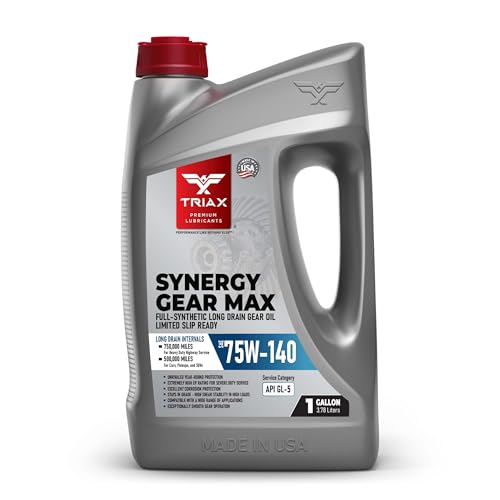
Best for: Heavy-duty trucks needing long drain intervals and high wear resistance. Why selected: TRIAX Synergy Gear MAX highlights extreme drain capabilities with very long mileage ratings and a wide OEM-spec coverage. It features a low pour point and strong wear protection, meeting API GL-5 and limited-slip requirements across multiple OEMs.
Notes: Its high load bearing capacity can be advantageous, but verify compatibility with your differential and axle seals before use.
ULTRA 1PLUS SAE 75W-140 Synthetic Gear Oil

Best for: All-season performance with anti-wear protection. Why selected: Ultra1Plus offers a high-performance formulation designed for year-round reliability, with anti-scuff additives that shield gears from wear. It aims to deliver stable film strength across varying temperatures, aligning with SAE J306 requirements.
Notes: As with any synthetic gear oil, confirm that the formulation matches your differential’s LS considerations and the vehicle’s manual recommendations.
Ford Genuine Fluid XY-75W140-QL SAE 75W-140

Best for: Ford-vehicle owners seeking OEM compatibility. Why selected: This is the genuine Ford axle lubricant formulated specifically for Ford axles, ensuring proper fit and performance when used in compatible Ford models. It is a practical choice for users prioritizing OEM-grade fluids.
Notes: OEM fluids are typically designed for specific Ford configurations; verify compatibility with your exact model and differential type.
Valvoline SynPower 75W-140 Pack of 4

Best for: Fleet managers and multi-vehicle owners. Why selected: Pack-of-4 options are convenient for planned oil changes across several vehicles and help standardize maintenance. The per-pack data highlights strong wear protection and wide temperature coverage for varied regions.
Notes: Check per-vehicle requirements to avoid over-purchasing or mismatched specifications in mixed fleets.
Parts Synergy SAE 75W-140 Synthetic Differential Fluid

Best for: BMW 1-Series owners and similar applications needing a synthetic API GL-5 option. Why selected: This product provides a synthetic base with API GL-5 compatibility, aligned with 75W-140 viscosity for robust protection in demanding driving scenarios.
Notes: Confirm vehicle compatibility and OEM recommendations before use, particularly in performance-tuned or European-market models.
ULTRA 1PLUS SAE 75W-90 Full Synthetic Gear Oil

Note: This listing is for 75W-90, not 75W-140. If seeking 75W-90 alternatives, this product provides all-season protection with strong wear resistance and limited-slip compatibility. Best for: Users needing a slightly lighter viscosity in colder climates or older gear designs where 75W-90 is specified.
Buying Guide
What does API GL-5 and 75W-140 mean for my differential?
API GL-5 is a gear oil specification for hypoid gear sets and high-load conditions. 75W-140 denotes the viscosity, providing thick-film protection at high temperatures while remaining fluid enough at cold starts. Choose GL-5 when your vehicle requires robust shear stability and slip performance.
Which features matter most for heavy loads and towing?
Look for: limited-slip readiness, anti-wearing additives, long-drain capabilities, and good cold-temperature flow. Oils with anti-scuff or anti-wear chemistry help gear teeth survive shock loads. If towing or heavy-duty use is common, prioritize wear protection and high-load performance claims.
How important is packaging and ease of pour?
Some products offer convenience features like squeezable pouches or easy-pour designs. Packaging can reduce handling time, but ensure it does not compromise seal integrity after storage. For fleet use, consider kits or packs for planned maintenance.
OEM vs aftermarket fluids
OEM fluids (like Ford OEM XY-75W140-QL) ensure compatibility with specific axles. Aftermarket synthetic GL-5 75W-140s often provide equal or superior performance at a lower cost, with broader vehicle applicability. Check your owner’s manual and differential type to decide.
Maintenance considerations
Regular oil changes, correct fill levels, and using the recommended viscosity are critical. If your differential has limited-slip components, ensure the chosen oil supports LS needs to minimize chatter and wear.
FAQ
- What does 75W-140 mean? It indicates viscosity: 75W at cold temps and 140 at high temps, delivering robust protection across seasons.
- Is GL-5 suitable for all rear differentials? GL-5 covers many hypoid gear sets, but check OEM requirements for your vehicle and any limited-slip specifications.
- Can I mix brands of 75W-140 gear oil? Mixing is generally not recommended; use the same product line per the OEM guidance or consult a technician.
- Is OEM fluid better than aftermarket? OEM fluids ensure compatibility with specific axles, while high-quality aftermarket oils may offer similar performance with broader compatibility.
- How often should I change 75W-140 gear oil? Drain intervals vary; follow the vehicle manufacturer’s guidelines or fleet maintenance schedules for long-life synthetic oils.
- What about 75W-90 as an alternative? 75W-90 provides different cold-weather behavior and is suitable where a lighter viscosity is specified, but it may not meet all GL-5 high-load requirements.