When selecting sandpaper for auto painting, the goal is to achieve a flawless, smooth surface at each stage of finishing. This guide highlights five top options that cover coarse shaping, body filler smoothing, and fine polishing. It helps you decide which sandpaper is best for beginners, DIY enthusiasts, and professional body shops. The recommended products balance durability, versatility, and ease of use for auto body prep and finish work. See the quick comparison table below to choose the right set for your project.
| Product | Grit Range | Best For | Notable Note |
|---|---|---|---|
| Mkobon 27 Pcs Sanding Sponge Pads | 120–3000 | Full prep and polishing, curves and edges | Flexible, reusable sponges |
| VRKET 3-in-1 Wet Dry Sandpaper Set | 80–3000 | All stages with holder for easy one-handed use | Includes sanding holder and sponges |
| 3M Wetordry Sandpaper 600 Grit | 600 | Primer scuff and blend areas | Excellent for wet or dry sanding |
| 3M Sandpaper 220 Grit | 220 | Coarse shaping and material removal | General purpose, versatile |
| POLIWELL Pyramid Structure Sandpaper Set | 1500/3000/5000 | Clear coat scratch repair and final smoothing | Pyramid grit for better edge coping |
Mkobon 27 Pcs Sanding Sponge Pads

The Mkobon set provides 27 sanding sponges with a wide grit range from 120 to 3000. This combination supports every stage from rough shaping to fine polishing, including demanding edges and curves common in auto panels. The surface uses a premium aluminum oxide layer with a soft flocking backing for strength and flexibility, and the sponges can be cut or bent as needed for complex shapes. Best for DIY auto body prep, wood, metal, and drywall projects. Caution: sponges may wear with heavy use and should be cleaned and dried between sessions to extend life.
VRKET 3-in-1 Wet Dry Sandpaper Set

This set covers 16 grits from 80 to 3000 with 3 sheets per grit, plus a dedicated sandpaper holder and two sponges. It’s ideal for auto body prep because you can progress from rough material removal to ultra-fine polishing without changing sheets. The front and back sponge surfaces accommodate different tasks, and the holder enables one-handed operation for better control on curves. Choose this if you want a complete, all-in-one kit for car panels, furniture, or metal finishing. Limitation: loading and alignment on the holder matters for consistent results.
3M Wetordry Sandpaper 600 Grit

600 grit is ideal for blending primer and refining the area before applying the base color. It works well for both wet and dry sanding, which makes it versatile during color coats. This grit is chosen when preparing the transition area between primer and paint and for smoothing minor imperfections. Best for professionals and experienced hobbyists who need precise scuffing without removing too much material. Caution: avoid over-sanding clear coats, which can thin the finish.
3M Sandpaper 220 Grit

Low-grit sheets at 220 help with initial material removal and rough shaping. This grit is best for prepping damaged panels, removing heavy oxidation, or breaking into a surface before finer grits. It’s a general-purpose choice suitable for paint, wood, and metal. Best for beginners who need straightforward material removal, but avoid using high-pressure on delicate edges to prevent gouging.
POLIWELL Pyramid Structure Car Sandpaper
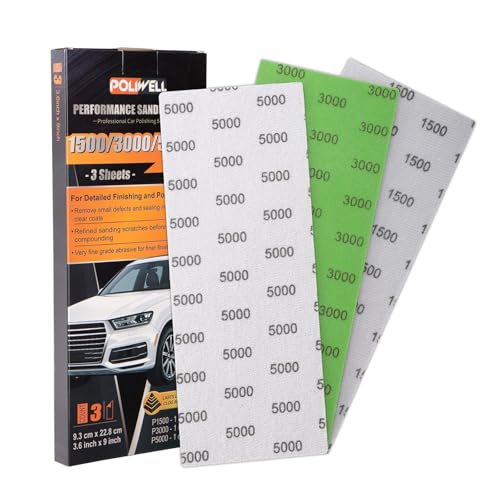
The POLIWELL kit focuses on clearcoat scratch repair with three grit levels: 1500, 3000, and 5000. The pyramid structure provides multi-directional cutting and better debris dispersion, extending abrasive life and improving edge handling on curved surfaces. This is best for final smoothing and restoring a mirror-like shine on clear coats. A potential limitation is that this set emphasizes finer grits; you may need coarser sheets elsewhere for initial material removal.
Buying Guide: Key Purchase Considerations
- Project stage: Coarse shaping requires low grits (rough removal); finishing needs ultra-fine grits (polishing).
- Wet vs dry sanding: Wet sanding reduces dust and heat; it’s preferred for auto paint to protect clear coats.
- Backing and flexibility: Flexible sponges are ideal for curves and edges; rigid sheets work well for flat panels.
- Durability: Aluminum oxide and silicon carbide are common in auto work; choose sets with durable coatings for multiple uses.
- Convenience: All-in-one sets with a holder or blocks simplify handling and consistency on long projects.
- Edge handling: Pyramid grit designs can help manage complex surfaces and prevent clogging on curved areas.
Frequently Asked Questions
- What grit should I use before applying primer?
Use 320–600 grit for smoothing primer edges and blending transitions without creating deep scratches. - Should I use wet sanding for auto paint work?
Yes. Wet sanding helps reduce dust, cools the surface, and produces a smoother finish, especially on clear coats. - What is the advantage of pyramid structured sandpaper?
It distributes abrasion across multiple directions, reduces clogging, and extends sheet life on curved surfaces. - Can I mix brands for different stages?
Yes. Many auto body projects benefit from a combination: a coarse brand for shaping and a fine brand for polishing. - How do I prevent gouging edges?
Use light pressure, support the panel, and switch to finer grits as you approach edges and contours. - Is a sanding block necessary?
A sanding block or holder improves flatness and control, especially on large panels or even surfaces.