If you’re dealing with an oil leak, you want a reliable, fast-acting seal fix that works across common engine types. This guide reviews five widely available products designed to stop leaks in engines, transmissions, and related seals. It’s ideal for DIYers and drivers who want to avoid major repairs without lengthy downtime. The selections below are suited for everyday gasoline and diesel engines, with notes on best-use scenarios and limitations to help you choose the right product for your situation.
| Product | Best For | Notes |
|---|---|---|
| Bar’s Leaks OS-1 Oil Seal Engine Oil Burning & Leak Repair | Leaking main seals and gaskets | Versatile, compatible with many engine types |
| Bar’s Leaks Rear Main Seal Repair | Rear main leaks | Targets hard-to-stop leaks |
| ATP Automotive AT-205 Re-Seal Stops Leaks | Rubber seals & gaskets across systems | Fast-acting resealer |
| Lucas Oil 10278 Engine Oil Stop Leak | Renews worn seals, reduces oil consumption | Good compatibility with different oil types |
| BlueDevil Oil Stop Leak | Engine oil leaks across many engines | Permanent seal capability |
Bar’s Leaks OS-1 Oil Seal Engine Oil Burning and Leak Repair

Best for: Drivers with general engine oil leaks and burning oil symptoms. This product is designed to repair leaking main seals and gaskets in a wide range of gasoline and diesel engines, including turbocharged or EcoBoost systems.
Why selected: It combines a broad compatibility profile with a focus on renewing worn valve seals and guides, helping reduce oil loss and burning symptoms when leaks are present.
What to know: It’s most effective when oil consumption does not exceed one quart per day, and it should be used as directed to avoid overuse.
Bar’s Leaks Rear Main Seal Repair, 16.9 oz
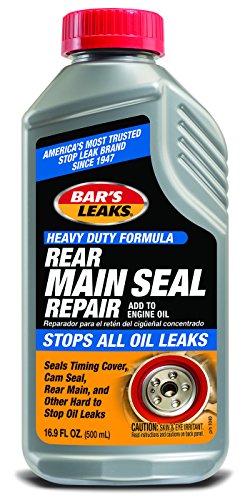
Best for: Leaks around the rear main seal and other hard-to-stop seals. Specifically designed to seal rear main leaks while also offering performance beyond conventional stop-leak products for other leaks.
Why selected: Its targeted action on rear main seals makes it a strong choice for vehicles showing leaks at the back of the engine, where leaks often worsen over time.
Caution: Results can vary by engine design; it’s wise to test a small amount first and monitor oil levels closely after application.
ATP Automotive AT-205 Re-Seal Stops Leaks, 8 Ounce Bottle

Best for: Sealing rubber seals and gaskets across engines, transmissions, power steering, differentials, and hydraulic systems. Works with conventional and synthetic oils as well as ATF and gear oil.
Why selected: Its professional-strength formula targets multiple rubber seals, offering broad utility in mixed-leak scenarios and reducing oil loss across several systems.
Caution: As with any additive, avoid excessive use and ensure compatibility with your vehicle’s oil type to prevent unintended reactions.
Lucas Oil 10278 Engine Oil Stop Leak – 1 Quart

Best for: Restoring worn seals and reducing oil consumption across a variety of oils, including petroleum, semi-synthetic, and full synthetic blends.
Why selected: It emphasizes renewing worn seals and easing oil consumption without risking engine damage, making it a practical option for vehicles with aging seals.
Limitation: Effectiveness depends on the extent of seal wear and the oil formulation in use; results may vary with extreme wear conditions.
BlueDevil Oil Stop Leak – 8 Ounce

Best for: A wide range of engine oil leaks with a focus on permanent sealing. Designed to halt drips and keep leaks sealed for miles of driving.
Why selected: BlueDevil emphasizes a permanent seal solution that maintains its effectiveness after driving, making it appealing for drivers seeking a long-term fix.
Limitation: It’s important to follow the recommended dosage and ensure compatibility with your engine type and oil system to avoid misapplication.
Buying Guide
Key considerations when choosing an oil leak seal fix?
- Leak location and severity: Rear main seals demand different products than valve seals or gaskets. Start with a product that targets the suspected location.
- Engine type and oil compatibility: Confirm that the product is compatible with your engine (gasoline vs diesel) and your oil type (conventional, synthetic, or blend).
- Single-use vs multi-system fixes: For multiple leaking areas, consider a multi-purpose formula that can address seals across engines, transmissions, and power steering.
- Expected results and maintenance: Some products offer quick, temporary relief; others advertise permanent sealing. Plan for monitoring oil levels after application.
- Vehicle age and wear: Worn seals may respond differently; high-mileage engines often benefit from products designed to rejuvenate seals.
- Usage guidelines: Follow dosage, mixing, and application instructions exactly to minimize risk of adverse effects on seals or engine oil balance.
FAQ
- Do these products work on diesel engines? Most are formulated for both gasoline and diesel engines, but always check the label for compatibility.
- Will these fixes prevent future leaks? They can seal current leaks, but wear and new damage can still occur; regular maintenance helps.
- Should I replace a leaking rear main seal instead of using a sealant? For persistent rear main leaks, professional diagnosis is recommended to determine if a mechanical repair is necessary.
- Is a permanent seal guaranteed? Some products claim permanent sealing; results depend on leak size, engine condition, and proper use.
- How soon will I see results? Some products show improvements quickly, while others require continuous use over a short period.