Answering the needs of car owners, DIY enthusiasts, and fleet managers, this guide highlights top tire inflator air tools that pair accuracy with ease of use. Each selection is best for quick inflation, precise pressure checks, or reliable dual-chuck operation in tight spaces. Use the summary to compare key capabilities at a glance.
| Product | Best For | Key Benefit |
|---|---|---|
| Spurtar 10-120 PSI Gauge with Inflator | All-around use, tight spaces | ANSI B40.1 Grade B accuracy (2%), dual head chuck |
| AstroAI Digital Tire Pressure Gauge with Inflator (3-250 PSI) | High-precision readings | 1% accuracy, 0.1 PSI resolution, all-in-one unit |
| AstroAI Tire Pressure Gauge with Inflator (100 PSI) | Standard passenger cars | Large 2.5″ dial, ANSI B40.1, universal compatibility |
| AstroAI T3 Heavy-Duty Tire Inflator | Hard-to-reach wheels | Dual-head chuck, ANSI B40.1 accuracy, 10-120 PSI |
| Nilight 50026R Digital Gauge + Inflator | All-in-one with multiple units | Backlit LED, 0-250 PSI, quick-connect |
Spurtar 10-120 PSI Heavy Duty Tire Pressure Gauge With Inflator

Best for versatile, everyday tire care. The Spurtar unit is calibrated to ANSI B40.1 Grade B (2%) accuracy, enabling precise readings and efficient inflation without a visit to a service station. Its dual head chuck design (5 11/16″ chrome iron stem) helps reach tight angles and inner wheels, while a 30-degree forward head and reverse chuck support outer wheels. This tool excels for drivers who frequently switch between cars, SUVs, and light trucks.
Best for: daily drivers and DIY enthusiasts who value accuracy and flexibility in confined spaces.
Caution: The 2% accuracy standard, while precise, may still show slight variation with extreme ambient temperatures or wear on fittings. Ensure a secure seal before inflating.
AstroAI Digital Tire Pressure Gauge With Inflator (3-250 PSI)
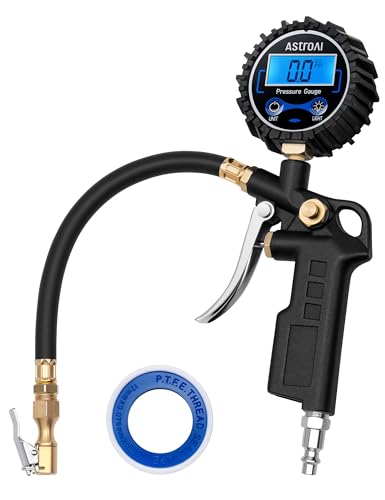
Best for high-precision monitoring. This digital gauge provides a 0.1 PSI resolution and 1% accuracy across a wide 3-250 PSI range. It includes straight locking chuck, hose, bleed valve, and inflation capability, making it a single-tool solution for inflating, deflating, and checking pressure. The unit is compatible with standard Schrader valves and common ¼” NPT air compressors.
Best for: drivers who want precise digital readings and a compact, all-in-one inflator solution.
Caution: Digital displays require battery power; replace batteries as needed to avoid mid-use outages. Use with compatible air sources for optimal results.
AstroAI Tire Pressure Gauge With Inflator, 100 PSI ANSI B40.1

Best for standard passenger vehicles needing a simple, reliable inflator. This AstroAI model features a large 2.5″ dial for easy reading and ANSI B40.1 accuracy. It supports inflation, deflation, and tire pressure checks, and is compatible with common ¼” NPT air compressors and quick-connect fittings.
Best for: value-conscious buyers who want a robust, easy-to-read instrument with inflation capability.
Caution: The 100 PSI range is sufficient for most passenger cars; heavier trucks or high-psi needs may require a broader range tool.
AstroAI T3 Heavy-Duty Tire Inflator

Best for reaching inner and outer dual wheels. The T3 highlights a dual-head chuck (straight and 30° reverse) designed for tight spaces and hard-to-reach valves. It includes ANSI B40.1 accuracy with a 10-120 PSI range, and it uses a ¼” NPT air connector for rapid attachment to most compressors.
Best for: technicians or DIYers who frequently service trucks, SUVs, or vehicles with limited access to valve stems.
Caution: Inflation requires an attached air pump; ensure a stable power and air supply before use to avoid inaccurate readings.
Nilight 50026R Digital Tire Inflator Gauge

Best for all-in-one versatility. The Nilight unit features a backlit display with PSI, KPA, Bar, and Kg/cm² readouts, plus a 0-250 PSI range and a stainless braided hose. It includes an inflation gun, chuck, gauge, and bleed valve, all in one package, making it suitable for varied tire types and conditions.
Best for: users who value a broad unit selection and a bright display for low-light conditions.
Caution: The larger feature set may add bulk; choose this if you need multiple unit formats and a backlit screen.
Buying Guide: Key Purchase Considerations
- Accuracy and range: Look for ANSI B40.1 accuracy ratings and a PSI range that covers your typical tires (10-120, 0-250, etc.).
- Chuck design: Dual-head chucks and 30° angles help access hard-to-reach stems; straight chucks suit straightforward access.
- Display and readability: Digital gauges offer 0.1 PSI resolution; analog dials are quick to read at a glance. Consider backlit displays for night use.
- All-in-one capabilities: Some models integrate gauge, deflate valve, inflation trigger, and hose—reducing tool clutter.
- Hose quality: A stainless braided hose tends to resist wear and increase durability under high pressure.
- Connectivity: Ensure compatibility with your compressor’s output (1/4″ NPT is common) and preferred fittings.
- Portability vs. versatility: Compact tools are easy to carry; larger all-in-one units provide broader unit options and measurements.
- Use case: Choose based on vehicle type (car, SUV, truck) and accessibility of valve stems in your regular use scenarios.
FAQ
- What is ANSI B40.1 standard?—It is a widely recognized accuracy standard for tire pressure gauges; many top tools advertise Grade B or similar tolerances around 2% to ensure reliable readings.
- Do I need a digital gauge?—Digital gauges offer higher readability and 0.1 PSI precision, which helps fine-tune tire pressures, especially for performance or off-road tires.
- Can I use these with all air compressors?—Most listed products support common ¼” NPT connections, but verify compatibility with your specific compressor model.
- Is a dual-head chuck important?—Dual heads improve access to inner and outer wheels and help you reach valves in tight spaces more easily.
- Should I deflate and inflate with the same tool?—All-in-one units typically handle both processes; if you frequently alternate between inflating and deflating, a unit with a bleed valve is advantageous.
- How often should I check tire pressure?—Check when tires are cold, especially before long trips or after temperature changes, to ensure accurate readings and optimal tire wear.