Real-time tire pressure monitoring is essential for confident motorcycle riding. This guide highlights five TPMS options that balance accuracy, ease of setup, and reliable alarms. The best picks suit riders who prioritize safety while commuting, long trips, or sport riding. Each product section explains who it’s best for and why it was chosen, with practical cautions when applicable. A quick buying table helps you compare core specs at a glance.
| Product | Best For | Key Benefit |
|---|---|---|
| leepee Motorcycle TPMS 5.0 | Tech-savvy riders needing app-based monitoring | Stable wireless app connection with multi-alert modes |
| FOBO Bike 2 (Black) | Android/iOS users who want DIY setup | Bluetooth 5.0, real-time alerts, no extra receiver |
| Liwogi TPMS | Riders who value robust alarms and magnetic charging | Real-time monitoring with multiple alarms and magnetic charging |
| Sykik Rider SRTP300 | Minimalist setup with a compact display | Smallest sensors and 1.5” monitor |
| KEMIMOTO TPMS | All-around reliability with IP67 protection | Real-time pressure/temp with wide compatibility |
Leepee TPMS 5.0 With External Sensors

The Leepee TPMS 5.0 offers real-time tire data via a dedicated mobile app. It supports iOS and Android with the “motorcare” app and provides high/low pressure, temperature, and battery alarms. It enters sleep mode after 10 minutes of inactivity to conserve energy, reactivating on vibration. Best for riders who want a feature-rich app experience and external sensors for easy installation. Consider this option if you prefer app-based alerts and are comfortable using a smartphone interface during rides. Caution: App performance may vary by device and OS version.
FOBO Bike 2 TPMS (Black)
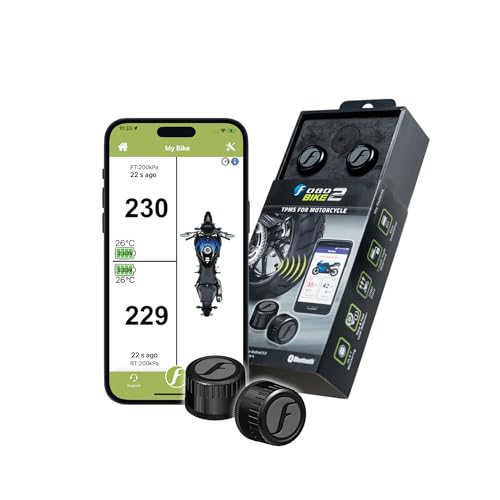
FOBO Bike 2 TPMS uses Bluetooth 5.0 for real-time tire pressure and temperature monitoring, with easy DIY installation and no separate receiver. It’s ideal for riders who want seamless smartphone pairing and constant awareness whether parked or on the move. Choose this if you value simple setup and ongoing Bluetooth connectivity. Limitation: Requires the FOBO app and a compatible smartphone; no standalone display.
Liwogi Motorcycle TPMS System

Liwogi’s TPMS emphasizes real-time monitoring with two external sensors and a strong emphasis on alarms—leakage, high/low pressure, high temperature, and battery or signal issues. It also features a magnetic charging approach to reduce wear on ports. Best for riders who want robust audible/visual alerts and a longer-term charging solution. Caution: Magnetic charging may require careful alignment during setup and charging.
Sykik Rider SRTP300 TPMS

The Sykik SRTP300 features a compact 1.5” monitor with the smallest sensors currently on the market and a rechargeable built-in battery. It favors riders who want a minimal setup and and a discreet display while maintaining reliable monitoring. Best for riders who need a compact, low-profile system. Limitation: The small display may be harder to read in bright sunlight or while wearing sunglasses.
KEMIMOTO Motorcycle TPMS System

KEMIMOTO’s system offers a reliable real-time pressure and temperature readout with IP67-rated external sensors. It supports a wide range of motorcycles and emphasizes hands-off maintenance with simple screw-on installation. Best for riders who want a sturdy, weatherproof TPMS with consistent data transmission. Caution: Not all valve stems are compatible; verify stem type before installation.
Buying Guide: What To Consider When Choosing a Motorcycle TPMS
- Monitoring method: App-based vs. dedicated display. App-based systems offer flexibility, while a built-in monitor provides instant visibility without a phone.
- Connectivity: Bluetooth vs. wireless app integration. Bluetooth models require pairing and may depend on phone proximity during riding.
- Sensor type and mounting: External sensors are common, but placement and stem compatibility vary by brand. Check for IP67 or higher ratings for weather resistance.
- Alarms and alerts: Look for high/low pressure, high temperature, rapid leakage, battery level, and signal loss alerts. Decide which alarms matter most for your riding style.
- Power and charging: Magnetic charging or USB options influence convenience and durability in rough riding conditions.
- Riding conditions: Off-road, touring, or urban commuting may benefit from different sensor layouts and alert sensitivity.
- Compatibility: Ensure the system supports your motorcycle’s valve stems and rim types.
FAQ
- Do motorcycle TPMS require an internet connection? Answer: Most rely on Bluetooth or a direct app connection to your phone. Some app-based systems communicate data via the phone’s internet when needed.
- Are external sensors weatherproof? Answer: Many sensors are IP67 or equivalent, designed to resist water, dust, and mud, but verify for your climate and riding style.
- Will TPMS work at high speeds? Answer: Yes, most TPMS are engineered to provide real-time data while riding at typical highway speeds.
- Can I install TPMS myself? Answer: Many models offer DIY installation with screw-on sensors; some may require professional mounting for compatibility with certain rims.
- How accurate are these systems? Answer: Most target ±2 PSI and a small temperature range variance; accuracy depends on sensor quality and installation.
- Is access to app data stored securely? Answer: Security depends on the vendor’s app. Check app permissions and data handling practices if concerned about privacy.