When choosing a trailer jack foot block, the goal is simple: maximize stability, minimize wobble, and fit your jack type. The top products below are selected for reliability, compatibility with common tongue jacks and stabilizers, and their capacity to handle rough outdoor conditions. Best for frequent campers, weekend-getters, and DIY RVers who want rock-solid support on gravel, grass, or pavement.
Overview of top picks: the table below highlights each block’s key strength and ideal use case. Use this as a quick reference while reading the in-depth product sections that follow.
| Product | Best For | Capacity | Notes |
|---|---|---|---|
| OX BLOX Heavy Duty Trailer Jack Block | Heavy-duty tongue jacks and stabilizers | Up to 10,000 lbs per block | Stackable; US-made from recycled plastic |
| RV Trailer Jack Block (Vacallity) | Versatile jacks and stability on varied terrain | Up to 16,000 lbs | HDPE; anti-slip design |
| ROBLOCK 6” Trailer Jack Block | Adjustable height on uneven surfaces | G.V.W 40,000 lbs per block | Stackable; robust polymer |
| OULEME Heavy Duty Trailer Jack Block | Stability on multiple jack types | Up to 15,000 lbs | Recycled plastic; tall height |
| Bullke USA-Made Trailer Jack Blocks | Strongest-available for motorhomes and trailers | Up to 18,000 lbs | UV resistant; multiple block sets |
OX BLOX Heavy Duty Trailer Jack Block
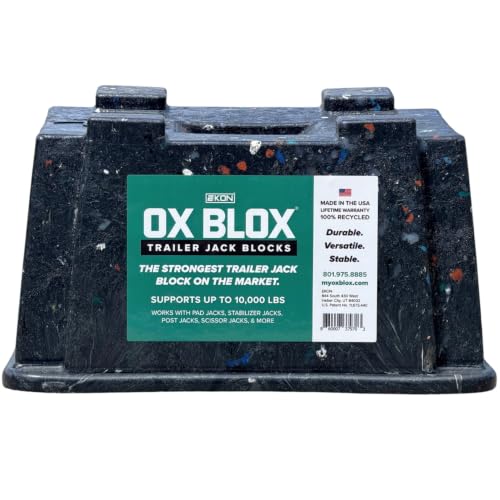
Best for: RV owners who need robust support for tongue jacks and stabilizers, including 5th wheels and travel trailers. This block is designed to handle up to 10,000 lbs per block and works as a jack stand, leveling block, or stabilizer pad on diverse surfaces. The stackable design enables extra height without sacrificing stability.
Why chosen: Its patented stability approach reduces wobble on gravel, grass, dirt, and pavement. The blocks are engineered to prevent sway during setup and while parked, making it a dependable option for campsites or job sites.
Caution: When stacking for height, verify load distribution to prevent tipping on sharply uneven ground. Not all jacks may align perfectly with every block height due to jack foot shape.
RV Trailer Jack Block (Vacallity)

Best for: Campers seeking high-clarity HDPE construction with broad jack compatibility. This block emphasizes durability and versatility across tongue jacks, leveling pads, wheel jacks, and stabilizers.
Why chosen: HDPE material provides long-lasting resistance to outdoor exposure. It’s designed to accommodate a wide range of jack feet and post heights, enhancing stability without sacrificing ease of use.
Caution: The design favors versatility, but users should confirm exact foot footprint compatibility with their specific jack model before purchase.
ROBLOCK 6”H Trailer Jack Block with Bag

Best for: RVers who want adjustable height blocks for uneven terrain and supports a load with a robust polymer build. It’s suitable for travel trailers and fifth wheels using tongue jacks, posts, feet, or stabilizers.
Why chosen: The block is stackable and designed to minimize movement once placed, supporting stable parking on varied ground. The included bag aids transport and storage, keeping blocks clean between uses.
Caution: Check stack height limits when planning a multi-block setup to maintain a safe center of gravity for the trailer.
OULEME Heavy Duty Trailer Jack Block

Best for: RVers who need a sturdy, tall option that supports up to 15,000 lbs per block. Works well with square and round jack feet and rounds out a stable leveling kit for larger trailers.
Why chosen: The block’s recycled plastic construction increases density and thickness, delivering solid rigidity and long-term durability. Its height supports significant adjustments for level ground.
Caution: Some users may notice slight surface texture variations due to forged plastic manufacturing. This does not impact performance but may affect cosmetic uniformity.
Bullke USA-Made Trailer Jack Blocks

Best for: Motorhomes and large trailers that require the strongest leveling support. The system is UV resistant and offers high capacity per block, up to 18,000 lbs, with multiple-block sets available for versatile leveling.
Why chosen: Made in the USA from recycled plastic with a forged design, these blocks emphasize durability and reliability under heavy loads. The UV resistance helps maintain performance in sun-exposed campsites.
Caution: Surface texture and color may vary between blocks due to the manufacturing process, which does not affect function but may affect uniform appearance in a setup.
Buying Guide: What To Consider When Selecting Trailer Jack Blocks
What capacity do you need? Start by matching your heaviest potential load (trailer tongue weight plus equipment) to a block’s per-block rating. If you frequently park on soft ground, consider higher-height, stackable options that maintain stability when stacked.
What jack type do you own? Blocks vary in compatibility with tongue jacks, post jacks, wheel jacks, and stabilizers. Check whether your foot size, shape, and mounting method align with the block’s top surface and footprint.
Material and durability: Recycled plastics and UV-resistant polymers are common. HDPE and reinforced plastics tend to offer good impact resistance and weather durability for outdoor use.
Height adjustability: Stacking ability is a key feature for uneven surfaces. Ensure your chosen blocks can be stacked safely to reach the required height without risking tipping or instability.
Portability and storage: If you travel frequently, look for blocks with carrying handles or included storage bags. Compact blocks and bags simplify transport and reduce clutter in your trailer’s storage area.
Surface and stability features: Anti-slip surfaces, ribbed textures, and rounded corners can improve grip on gravel, dirt, and grass. A stabilized base helps prevent sinking into soft ground.
Maintenance and care: Easy-to-clean blocks are beneficial after muddy or sandy campsites. UV-resistant finishes reduce surface wear and color fading over time.
Frequently Asked Questions
- What size trailer jack block should I choose for a 5th wheel? — Choose blocks rated for higher capacity (often 10,000–18,000 lbs per block) and ensure compatibility with your jack foot style and height requirements.
- Are stackable blocks safe for uneven ground? — Yes, when properly stacked and used within their weight rating. Distribute the load evenly across the feet to reduce tipping risk.
- Can these blocks be used with any jack type? — Many are designed to be versatile, supporting tongue jacks, post jacks, stabilizers, and wheel jacks. Always verify compatibility with your specific model.
- Do I need to seal or treat these blocks for weather protection? — Most blocks are UV-resistant and designed for outdoor use without extra treatment. Regular cleaning is sufficient in most cases.
- How many blocks should I carry for my RV? — It depends on your trailer weight, terrain, and desired height. A small set of 2–4 blocks with a range of heights covers most leveling scenarios.
- Should I use blocks on concrete or pavement? — Blocks work on all stable surfaces, but extreme heat or cold can affect joint behavior. Ensure a flat, stable base for best results.