Answering the main buyer question: which PWM speed controller box is best for trolling motors? This guide highlights five reliable, widely compatible options that fit most 12–70V trolling motor setups. Each pick targets a common need—compact DIY builds, robust cooling, bidirectional control, or simple plug-and-play reliability—so you can choose confidently. Ideal for anglers, small-boat operators, and hobbyists seeking smooth speed control and dependable performance on the water.
| Product | Voltage Range | Current (A) | Best For |
|---|---|---|---|
| DC Motor Speed Controller Max PWM 3500W (WUMZIJ) | 10–50V | 60 (max 100) | High-power setups; boats with robust motors; fans for cooling |
| Industrial Grade PWM DC Motor Speed Controller (HARMNEE) | 10–50V | 60 (max 100) | Rugged, CW/CCW with fuse; steady operation in tougher conditions |
| RioRand 7-70V PWM DC Motor Speed Controller (Green) | 7–70V | 30 | DIY projects; lightweight, compact builds; hobby motors |
| KooingTech 12–60V 40A PWM Controller | 12–60V | 40 | Reversible drive and stable speed control for small trolling motors |
| TKXEC Adjustable Digital Display PWM Controller | 10–55V | 60 (continuous 40) | Digital readout and precise 0–100% speed control for brushed motors |
WUMZIJ 3500W PWM Speed Controller
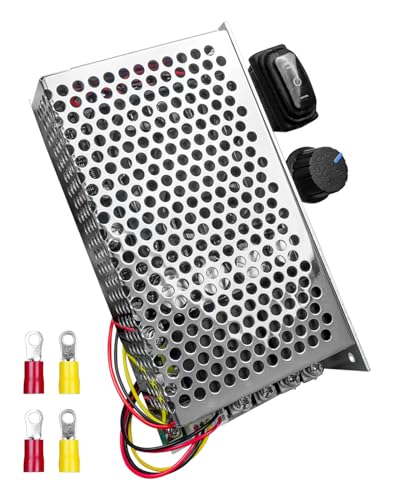
Best for high-power trolling motors on larger craft. Voltage range is 10–50V with a rated current of 60A and a max of 100A. It supports 0%–100% speed control and offers an adjustable potentiometer with a detachable plastic knob cover for panel mounting. A built-in cooling fan improves heat dissipation for sustained operation. Best for boaters who require strong motor performance and a robust cooling solution. Caution: ensure the motor current does not exceed the controller’s max rating to avoid overheating.
HARMNEE Industrial Grade PWM DC Motor Controller

Designed for tougher environments, this controller matches 10–50V inputs with 60A rated current and up to 100A max. It includes a professional cooling fan to support safe, steady operation. A CW/CCW switch provides easy direction control, making it suitable for boats requiring reliable bidirectional trolling. Best for users who need a durable, industrial-grade unit with straightforward direction changes. Limitation: ensure ample space for the cooling fan and ventilation in compact installs.
RioRand 7-70V PWM DC Motor Speed Controller (Green)

Best for DIY projects and smaller trolling motors. Works from 7–70V with 30A current and supports 1%–100% duty cycle at 12kHz PWM. It uses a durable aluminum housing and includes an extra fuse for backup. Best for hobbyists who want a lightweight, heat-managed controller for hobby motors and small devices. Limitation: the lower current rating may not suit high-thrust trolling motors found on larger vessels.
KooingTech 12–60V 40A PWM Controller

Choose this if you need reversible torque and dependable speed steps for smaller trolling motors. Voltage range is 12–60V with 40A output, and it uses PWM to provide stable, adjustable speed. Best for DIY users wanting a compact package with clear forward/reverse control. Caution: ensure the load current does not exceed the 40A continuous rating for extended use, and consider heat management in enclosed installations.
TKXEC Adjustable Digital Display PWM Controller

Best for precise monitoring and control of brushed motors. Voltage range is 10–55V with a maximum 60A rating and 40A continuous current. Features a digital display showing motor speed percentage (0–100%), enabling accurate speed adjustments. The unit offers forward, brake, and reverse control for versatile trolling setups. Limitation: designed for brushed motors, not compatible with brushless configurations without adapters.
Buying Guide
Key considerations when choosing a trolling motor PWM box include voltage compatibility, continuous and peak current ratings, and cooling needs. For high-thrust setups, prioritize units with higher current capacity and active cooling. If bidirectional movement matters, select models with CW/CCW switching. For DIY projects, compact form factors and easy wiring help speed up installation. A digital readout can aid in precise speed tuning, while extra fuses and robust housings improve reliability in marine environments.
- Voltage compatibility: Match the controller to your battery bank and motor rating to avoid overloading.
- Current handling: Choose a controller with a continuous current rating that exceeds the motor’s draw in peak conditions.
- Cooling: Active cooling (fans) or robust aluminum housings help prevent overheating on long runs.
- Direction control: If you need precise maneuvering, ensure reliable CW/CCW or brake functionality.
- Durability: Marine-grade housings and weather protection extend controller life on the water.
Frequently Asked Questions
- What voltage range should I look for in a trolling motor PWM box?
Answer: Most trolling motors operate in the 12–60V range; select a controller within your battery system’s voltage window. - Do I need a high-current PWM controller for my trolling motor?
Answer: Yes, if your motor draws high current, choose a controller with a higher continuous rating than the motor’s peak draw to prevent overheating. - Can PWM controllers be used with brushed and brushless motors?
Answer: Most examples here are for brushed DC motors; brushless setups typically require different controllers or additional hardware. - Is CW/CCW switching necessary for trolling boats?
Answer: It helps with maneuverability, especially in tight waters; ensure your chosen model provides a reliable direction switch. - What maintenance helps extend PWM controller life?
Answer: Ensure proper ventilation, avoid exposure to saline spray without protection, and inspect wiring for wear or loose connections regularly.